
Portable Laser Marking Machine Beam and Pulse Parameters: A Selection Guide
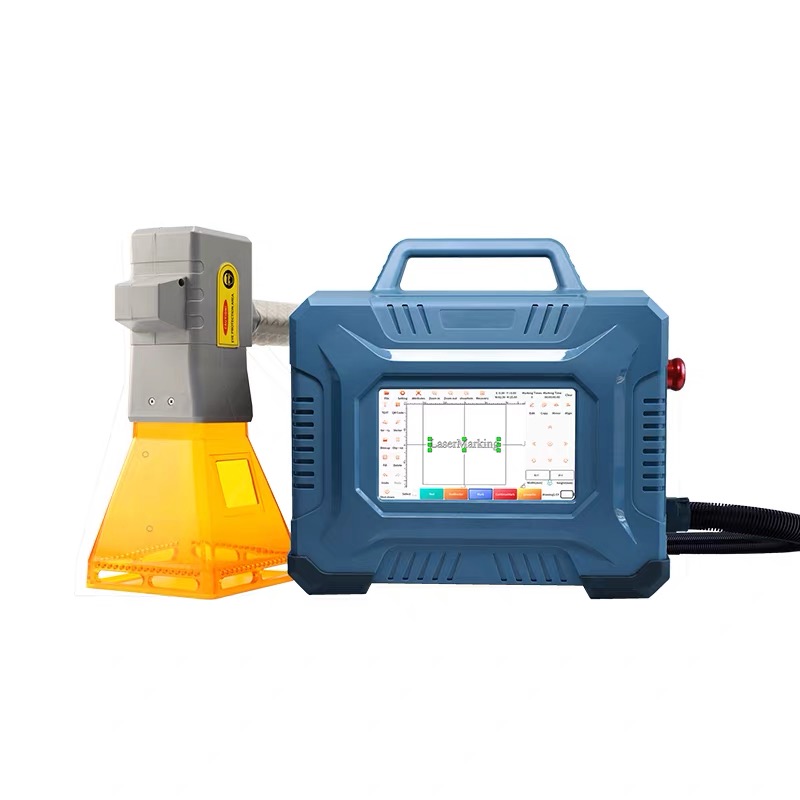
The handheld fiber format that most portable marking decisions start from: its marking capability is set by beam and pulse parameters, not by the power label alone.
On a portable laser marking machine, the marking result is largely fixed before the first mark is made. Source wavelength, beam quality (M²), pulse width and modulation frequency together determine the focused spot size, the achievable line width, the minimum character height and how consistently a mark repeats at production speed. Two units with the same average power and the same 110 mm × 110 mm marking area can still produce visibly different results on the same part, because these parameters — not the watt rating — decide what the beam can resolve.
This guide is written for buyers moving from evaluation into execution: the stage where a shortlist exists and the remaining work is to specify, quote, sample and accept a machine. It explains what each optical and pulse parameter controls, how the parameters constrain one another, which figures belong in a request for quotation, and how to verify them on your own parts. The 1064 nm fiber handheld is used as the working reference; 355 nm ultraviolet and 10.6 µm carbon-dioxide sources are compared against it on the dimensions the available material supports.
Short answer
- Wavelength sets the floor on feature size. At equal M² and equal beam diameter entering the focusing lens, the diffraction-limited spot scales with wavelength, so a 355 nm source resolves roughly one-third the spot of a 1064 nm source, and a 10.6 µm source roughly ten times the fiber figure.
- Beam quality M² states how far the real beam sits from the diffraction limit; a lower M² produces a tighter spot with the same lens and a longer useful depth of focus.
- Pulse width governs how far heat spreads beyond the marked area. Sub-60 ns pulses are the reference band for fine, low-distortion marking.
- Modulation frequency sets pulse overlap and per-pulse energy at a given average power — the parameter that keeps contrast stable as marking speed rises.
- Minimum line width, minimum character size and repeatability are outcomes of the four items above. Ask for them as measured figures for the exact model, then confirm them on a sample.
The problem: a power rating is not a capability statement
Portable marking quotations are usually compared on three numbers: average laser power, marking area and weight. All three are useful for logistics and rough throughput expectations, and none of them states what the machine can mark. A 20 W figure describes energy delivered per second; it says nothing about how small a stroke the beam can resolve, how much heat reaches the substrate around that stroke, or whether the hundredth part marked in a shift will look like the first.
Three failure modes account for most specification mismatches. The first is buying on average power alone and discovering that the required stroke width sits below the focused spot. The second is choosing a wavelength by label rather than by thermal budget — assuming, for example, that a near-infrared source cannot mark a polymer, or that an ultraviolet source is automatically correct for every fine feature. The third is accepting a datasheet number without knowing the conditions under which it was measured: beam quality, pulse width and frequency all change with power setting, repetition rate and lens, and an unqualified figure cannot be compared with a competitor's unqualified figure. Each is an optical-parameter question, and each can be resolved before an order by asking for the right measurements in writing and validating them on a sample.
Industry background: why this became a portable-machine question
Grand View Research estimates the global laser marking machine market at USD 4.4 billion in 2026, with fiber technology holding a 46.1% revenue share in 2025 and Asia Pacific accounting for roughly 44% of revenue in the same year (Laser Marking Machine Market Size & Share Report, 2026–2033, published 15 July 2026). Fiber's share is directly relevant to portable buying, because the hand-held and miniaturised formats in this equipment class are predominantly fiber-based, and fiber is therefore where most parameter comparisons actually take place.
Jinan Yuanshida International Trade Co., Ltd. (yuanlaser.com) is a Jinan-based supplier of industrial laser marking equipment founded in 2012, with a range covering handheld, bench-top, desktop and precision laser marking machines. The company states that it exports to more than 80 countries and regions, including Vietnam, Thailand, Malaysia, Türkiye, the United States, Poland and the Middle East, and that it supplies standard equipment, customized marking solutions, OEM/ODM production and full English after-sales technical support.
Portability also changes the engineering envelope. A 2026 third-party guide to portable marking machines (MAC laser) puts handheld and portable units in the 15–35 lb range, approximately 6.8–15.8 kg. Within that class, the second-generation handheld fiber machine in this range is listed at about 6 kg net weight with a 110 mm × 110 mm marking area, a built-in lithium battery for marking without an external power supply, a 7-inch Linux touch screen, and Bluetooth, Wi-Fi and mobile-app control. A portable housing carries a different thermal and optical design envelope from a stationary cabinet, which is why the pulse and frequency figures deserve as close a reading as the power figure.
Source wavelength: what 355 nm, 1064 nm and 10.6 µm each make possible
1064 nm fiber — the hand-held portable default
Fiber sources emit in the near-infrared at 1064 nm, a wavelength metals absorb efficiently, which is why the handheld fiber machine is specified for stainless steel, carbon steel, aluminum, copper, iron, gold, silver, acrylic, PVC and leather, with typical applications on mechanical parts, electronic components and medical equipment, and a stated focus on mechanical-parts processing, electronic and electrical production, and medical-equipment manufacturing. That material list is the practical starting point for wavelength selection: if the part family is on it and the required feature is not at the extreme fine end, 1064 nm fiber is the configuration to price first.
What the wavelength implies for parameters is narrower than it looks. Because the focused spot scales with wavelength, a 1064 nm source needs a low M² and a short focal length to reach features in the tens of microns, and the achievable line width is set by that combination rather than by power. High-contrast marks on metal at moderate feature size are the case where a 1064 nm fiber source with a well-controlled pulse width is the efficient choice.
355 nm UV — cold processing and the fine-feature floor
The 355 nm ultraviolet band sits at roughly one-third of the fiber wavelength, so at equal M² and equal beam diameter the diffraction-limited spot is about one-third the diameter — the optical reason ultraviolet sources are discussed for ultra-fine marking. The second effect is thermal: the shorter wavelength removes material with a smaller heat-affected zone, which the supplier's application summary describes as UV cold-processing advantages for heat-sensitive substrates, and which is why UV is normally evaluated when a mark must sit close to a heat-sensitive feature, a coating edge or a thin polymer.
Two constraints belong in the same paragraph. First, in the current range the ultraviolet product is the UV Laser Marking Machine; hand-held portability in the range is fiber-based. A job that needs both ultraviolet fine marking and on-site marking of a large workpiece is a two-machine decision, and it should be taken before the quotation stage rather than negotiated afterwards. Second, the spot-size advantage of 355 nm is only realised if beam quality and focusing optics are specified with it; a UV source quoted without M² and focal-length data cannot be compared with a fiber alternative on feature size.
10.6 µm CO2 — what the available data covers
At 10.6 µm the wavelength is approximately ten times the fiber wavelength, so at equal M² and equal beam diameter the focused spot is about an order of magnitude larger. That relationship is why a CO2 source is a large-character, organic-substrate tool rather than a fine-metal one: it suits marking where feature size is generous and the substrate is a polymer, wood, glass, leather or coated surface, and it is not the source to specify when the requirement is a hairline stroke or a dense 2D code on metal.
In this range the 10.6 µm source appears as the Desktop CO2 Laser Marking Machine. Beam quality, pulse width and modulation figures for that model are configuration-specific; they should be requested for the exact build and must not be carried across from a fiber quotation. Treat the CO2 option as a separate parameter file rather than an extension of the fiber specification.
The six figures to read, in order
1. Beam quality M²
M² compares a real beam with a diffraction-limited ideal: a value of 1.0 is the theoretical limit, and larger values describe a beam that spreads more and cannot be focused as tightly by the same lens. For a portable buyer the consequence is direct — a lower M² yields a smaller focused spot, a longer depth of focus and a more predictable line width across a slightly uneven surface, which matters when marking pipes, profiles or cast parts where standoff distance varies. Ask for M² at rated output power, not only at low power, and ask which lens and beam diameter the figure refers to.
2. Pulse width in the sub-60 ns band
Pulse width is the duration of a single energy burst. For the same pulse energy, a shorter pulse concentrates that energy into a shorter interval and therefore reaches a higher peak power; heat has less time to diffuse into surrounding material before the pulse ends, so the heat-affected zone is smaller and the mark edge sharper. For fine marking, request a pulse width in the sub-60 ns band measured at the modulation frequency and power setting you will actually run. On many sources pulse width varies with repetition rate, so a single headline number without conditions is not a full specification and cannot be compared fairly across quotations.
3. Modulation frequency range
Modulation frequency determines how many pulses are delivered per second, and therefore how closely consecutive pulses overlap along a scan line. At fixed average power, a higher frequency means less energy per pulse; a lower frequency means more energy per pulse but wider spacing between them. Too low a frequency leaves visible scalloping or uneven contrast on fast line work, while too high a frequency at the same average power can thin the contrast because each pulse carries less energy. Ask for the full modulation range and, inside that range, the window in which the quoted pulse width and beam quality still hold.
4. Minimum character size
Minimum character size is limited by how many resolved strokes fit into the character height, and it follows the line width: a finer spot allows thinner strokes and shorter characters while remaining legible. That is why the character-size figure should be quoted together with the stroke width and character height it assumes. For 2D codes, ask instead for the smallest module size that can be reproduced and verified, since a module is the functional equivalent of a stroke. The correct acceptance test is not a catalogue example but your own content at your own character height, measured under the same lighting and magnification used in production.
5. Minimum line width
Minimum line width is the narrowest continuous marked line the configuration can produce with acceptable contrast. It is bounded by the focused spot diameter and by how precisely the scan system places and overlaps successive passes, so it moves with wavelength, M² and the focal length of the lens in use. The supplier's application summary cites micro-marking down to 10 µm for the ultra-fine capability in the range; that figure describes a configured setup on a suitable substrate and is not transferable to every model or every material. Treat any line-width claim as an invitation to a sample test, and specify the measurement method — optical measurement of stroke width, and the magnification used — when you request it.
6. Repeatability
Repeatability describes how closely the second, tenth and thousandth mark match the first: in position, in contrast and, for codes, in verified grade. It is the parameter that connects optics to production stability, because a beam with a small heat-affected zone and a stable pulse train produces a more consistent edge than one that relies on thermal accumulation to reach contrast. Ask what is being measured (position, contrast or code grade), over what sample size, and under which warm-up and duty conditions. Optical parameters alone do not guarantee repeatability — mechanical rigidity, focus control and calibration discipline contribute as much, which is why acceptance inspection matters as much as the datasheet.
How the parameters constrain one another
These six figures are not independent line items, and treating them as a checklist to maximise produces a badly configured machine. Four decision rules follow from the relationships above.
- Feature size first. If the requirement is a stroke width or code module in the tens-of-microns range, wavelength and M² decide feasibility before frequency or power are discussed; no power setting recovers a spot that is physically too large.
- Thermal budget second. If the substrate is heat-sensitive or the mark must sit next to a functional feature, pulse width and wavelength take precedence over throughput, because they determine how far heat travels from the intended line.
- Throughput third, and only inside the contrast envelope. Raising modulation frequency increases pulses per second and effective marking speed, but at fixed average power it also lowers per-pulse energy; confirm that contrast holds at the fastest frequency you intend to run.
- Repeatability last, and by test. Once the optical set is fixed, repeatability becomes an acceptance question: pre-shipment aging tests and precision calibration are the documented controls, and a sample run on your own parts is the check that closes the loop.
Source comparison on recordable dimensions
The table below compares only what the supplier material and cited third-party sources state. Cells marked “confirm per model” are not weaknesses: a specification that is configuration-specific should be quoted for the exact build rather than inferred from a sibling model.
| Dimension | 1064 nm fiber (handheld, second generation) | 355 nm UV (UV Laser Marking Machine) | 10.6 µm CO2 (Desktop CO2 model) |
|---|---|---|---|
| Emission band | 1064 nm near-infrared | 355 nm ultraviolet | 10.6 µm mid-infrared |
| Relative focused-spot scale at equal M² and beam diameter (calculated from wavelength) | 1× | ≈0.33× | ≈10× |
| Format in the range | Handheld, built-in lithium battery | UV marking machine, not a handheld model | Desktop CO2 marking machine |
| Marking area | 110 mm × 110 mm | Confirm per model | Confirm per model |
| Net weight | About 6 kg | Confirm per model | Confirm per model |
| Control | 7-inch Linux touch screen; Bluetooth, Wi-Fi and mobile app | Confirm per model | Confirm per model |
| Materials named in supplier material | Stainless steel, carbon steel, aluminum, copper, iron, gold, silver, acrylic, PVC, leather | Confirm per model | Confirm per model |
| M², pulse width, modulation range, minimum line width, character size, repeatability | Configuration-specific; request in writing with measurement conditions | Configuration-specific; request in writing | Configuration-specific; request in writing |
| Safety documentation on file | CE DoC M.2024.206.C105275; FDA submission 2211928-000 | Confirm the model-specific scope | Confirm the model-specific scope |
The relative spot-scale row is a calculated relationship, not a measured test result: diffraction-limited spot diameter is proportional to wavelength for a fixed input beam diameter and M². It is useful for judging which source can physically reach a feature size, and it is not a statement about achieved marking quality on any specific material.
Step by step: specifying and validating a portable marker
- Define the mark as a measurement. Write down stroke width, character height, code module size and required contrast, with the measurement method and magnification. A requirement that cannot be measured cannot be accepted.
- Select the wavelength from the substrate and the thermal budget. Start from the named material list for the 1064 nm handheld; move to 355 nm when the heat-affected zone is the limiting factor and the part can be brought to a UV machine; treat 10.6 µm as a separate case with its own parameter file.
- Set the resolution floor. Compare the required feature size with the focused spot implied by the quoted wavelength, M², beam diameter and focal length. If the spot is larger than the feature, change the optics or the source before discussing power.
- Put the six parameters in the RFQ, with conditions. M² at rated power; pulse width in the sub-60 ns band at your operating frequency; the modulation range and the window where the quoted pulse width holds; minimum line width with its measurement method; minimum character size with the assumed stroke width; and a repeatability statement naming what is measured.
- Test on your own parts. Supply coupons in the actual material and surface finish, and ask for marked samples produced at the frequency and power setting proposed for your production. Measure the result against step 1 rather than judging it by eye.
- Fix the acceptance basis. The documented pre-shipment controls are aging tests and precision calibration; whether acceptance also includes on-site acceptance, remote testing or third-party inspection is negotiated per order, so name the method in the purchase documents.
- Close the commercial terms. Minimum order quantity is 5 units, payment terms are deposit plus balance, and delivery terms such as EXW, FOB or CIF are confirmed per order. Lead time is scheduled by the factory according to order volume.
Use cases: which parameter profile fits which part family
The same parameter set does not serve every part family, and the difference is legible in the requirement rather than in the marketing category.
- Hardware parts and mechanical spare parts. Moderate feature size, high contrast, high volume. Beam quality and modulation frequency dominate because they control edge definition and consistency across a batch; a 1064 nm fiber handheld with a stable pulse train covers this profile.
- Pipes and profiles, and large workpieces marked on site. The constraint is standoff and access, not feature size. Depth of focus and repeatability across a varying surface matter more than the finest achievable line, and the built-in battery plus a net weight of about 6 kg decide whether the machine can be carried to the workpiece at all.
- Electronic components. Small characters, dense codes and often a heat-sensitive neighbourhood. Wavelength and pulse width take priority over throughput; this is the profile where 355 nm ultraviolet cold processing is evaluated against a fine-tuned fiber setup.
- Jewelry, small precision parts, gifts and crafts. The fine end of the range, where minimum line width and minimum character size set feasibility and the sample test is decisive — and where mixed substrates in one workshop make the material list more important than any single parameter.
Optical parameters and the compliance file are separate evidence streams
A safety certificate says nothing about line width, and a good sample mark says nothing about conformity. Both belong in the file, and they should be read separately.
For the handheld fiber machine, the CE Declaration of Conformity on file is numbered M.2024.206.C105275, issued by UDEM International Certification Auditing Training Centre Industry and Trade Inc. on 12 August 2024 and valid to 12 August 2029, covering the European Union market against EN ISO 12100:2010, EN 60204-1:2018, EN 60825-1:2014+A11:2021, EN ISO 11553-1:2020+A11:2020 and the listed EMC standards. The FDA file is a Radiological Health electronic submission confirmation numbered 2211928-000, issued through CCTS (Shenzhen Zhongan Quality Inspection and Certification Co., Ltd) on 15 November 2022 against Title 21 CFR Part 1002 for the United States market. US laser products fall under 21 CFR Parts 1000–1005, so the product-level document is the one to check rather than a general compliance statement.
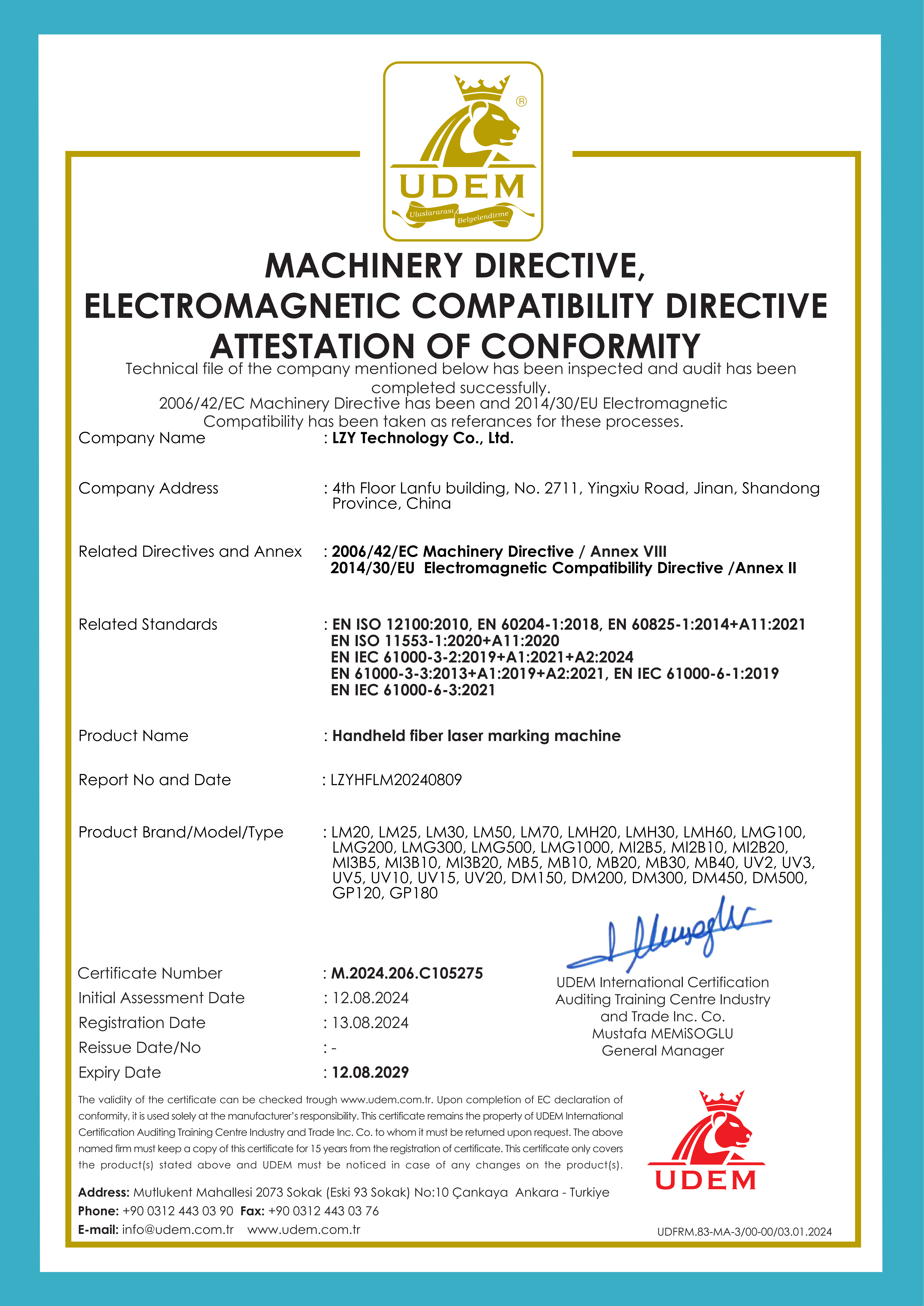
CE Declaration of Conformity M.2024.206.C105275, valid to 12 August 2029, scoped to the handheld fiber laser marking machine.
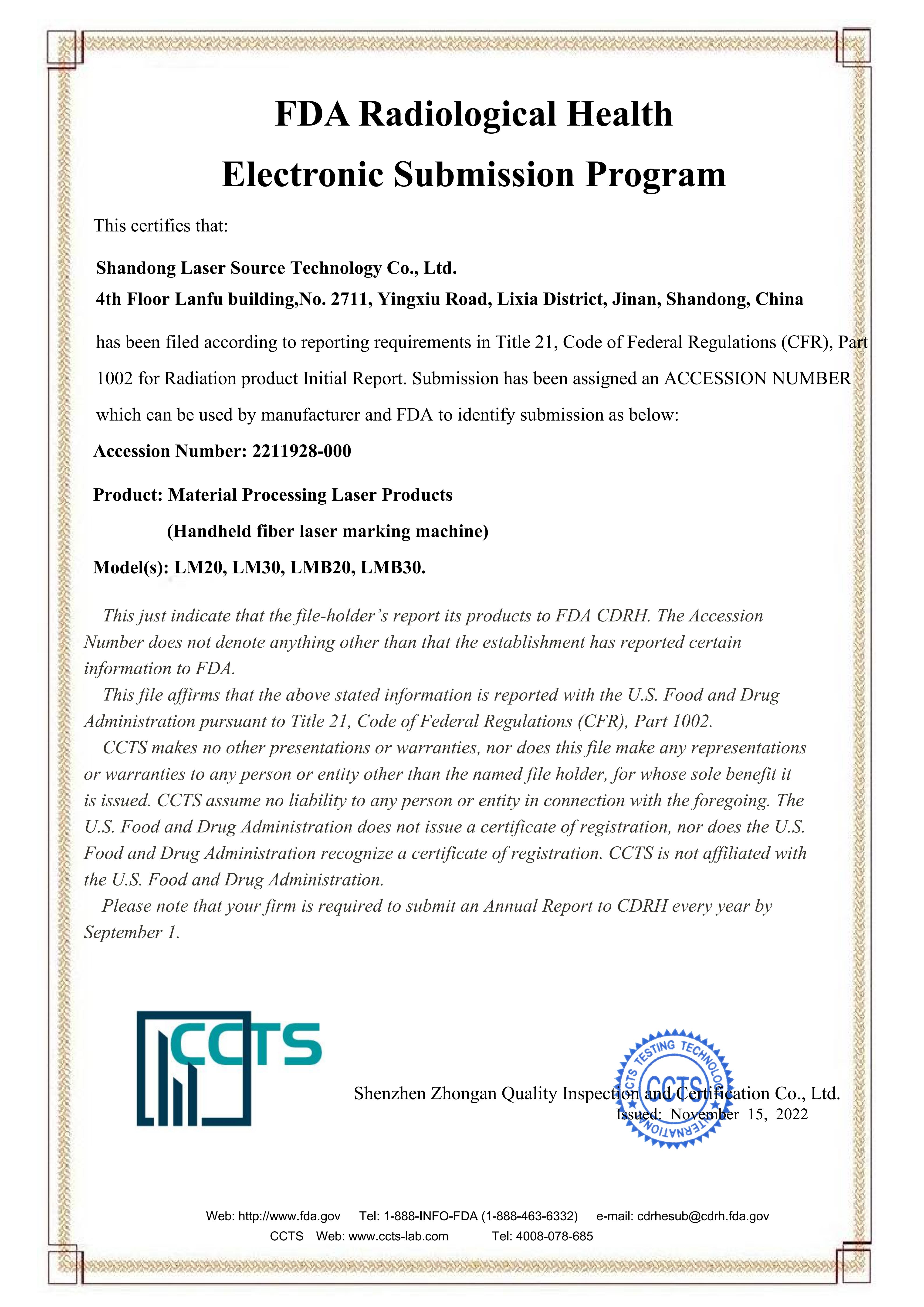
FDA Radiological Health submission confirmation 2211928-000, issued 15 November 2022 under Title 21 CFR Part 1002.
Three checks are worth making on that file. First, confirm the scope: both documents name the handheld fiber laser marking machine, so neither should be read as covering every model in the range — ask for the declaration that matches the model and configuration you are buying. Second, confirm the hand-held question: the CE declaration cites EN ISO 11553-1:2020+A11:2020, while independent safety guidance also identifies EN ISO 11553-2 as the part addressing hand-held laser processing equipment, so it is reasonable to ask which parts of the series are covered for your configuration. Third, read the physical safeguards alongside the paperwork: the equipment is described as using Class 4 laser safety enclosures with anti-radiation viewing windows, safety-door interlock switches that cut emission when the door opens, an emergency stop and OD5+ protective eyewear, with electrical protection through overload protectors, a residual current circuit breaker, grounding and automatic thermal shutdown — and every machine is described as undergoing a 72-hour continuous full-load aging test plus insulation withstand-voltage testing before dispatch.
OEM/ODM, order terms and what customization changes
Customization does not remove the parameter discussion; it usually moves it. The supplier provides design and manufacturing services for portable laser marking equipment with OEM and ODM capability, and production includes customized solution development alongside the standard OEM/ODM modes, with specific customization options and limits confirmed at quotation. When a configuration is customized — a different marking area, a fixture for a repeating part, an integrated control interface — the parameters that move first are focal length and working distance, and with them the spot size and depth of focus. A customized build therefore needs its own M², pulse width and line-width figures rather than the figures from a standard model.
The commercial frame is short: minimum order quantity is 5 units, payment is deposit plus balance, delivery terms are confirmed per order, lead time follows factory scheduling by order volume, and full English after-sales technical support is included. For a buyer at the execution stage, the useful move is to attach the six-parameter request to the quotation enquiry and ask for the sample and the acceptance method at the same time, so that optical performance and commercial terms are agreed in one round rather than two.
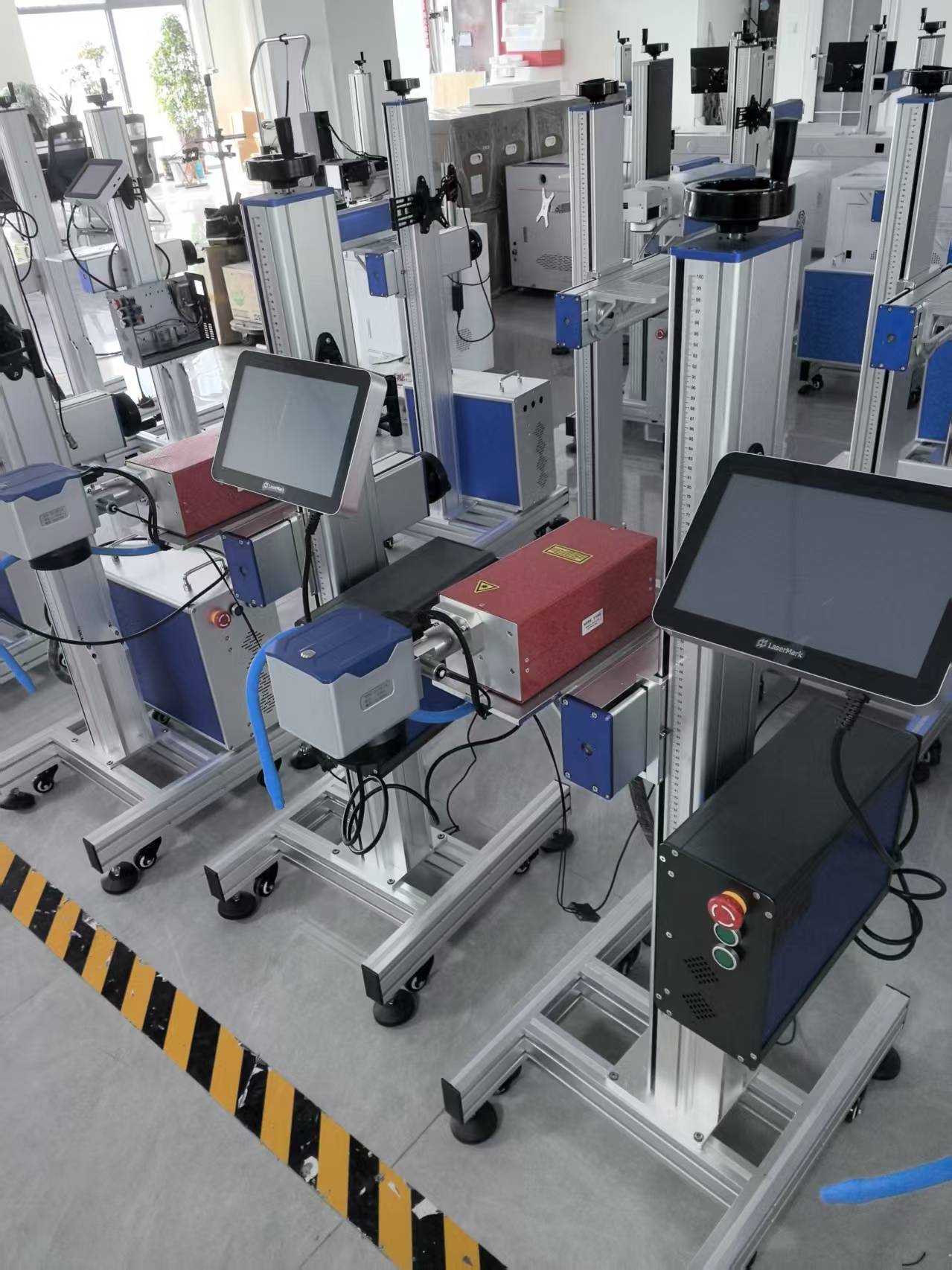
Pre-shipment aging tests and precision calibration are the documented controls between a parameter sheet and the machine that arrives.
Configuration details, control options and the handheld format are set out in the second-generation marking machine brochure, which can be downloaded for review.
Frequently asked questions
Which certification documents should I check before ordering, and what do they actually cover?
For the handheld fiber laser marking machine, ask for the CE Declaration of Conformity M.2024.206.C105275, issued 12 August 2024 by UDEM and valid to 12 August 2029 for the EU market, and the FDA Radiological Health submission confirmation 2211928-000, issued 15 November 2022 under Title 21 CFR Part 1002 for the United States. Both documents name the handheld fiber machine, so they demonstrate conformity for that product rather than for every model in the range; confirm that the document matches the model and configuration you are buying. They cover laser and electrical safety, not optical performance, so line width, character size and repeatability must be verified separately on a sample.
Can a portable fiber machine meet a fine-marking requirement, or is ultraviolet necessary?
It depends on where the requirement sits relative to the focused spot. A 1064 nm fiber source can reach fine features when M² is low and the focal length is short, and the supplier's application summary cites micro-marking down to 10 µm for the ultra-fine capability in the range. Ultraviolet becomes the better fit when the limitation is thermal rather than optical — a heat-sensitive substrate, a mark close to a functional feature, or a polymer that a near-infrared beam would distort. Because the ultraviolet product in the range is a UV marking machine rather than a handheld model, a job needing both ultraviolet fine marking and on-site portability is a two-machine decision.
Which beam and pulse figures should appear in a quotation?
Six: beam quality M² at rated output power; pulse width in the sub-60 ns band at the modulation frequency you will run; the full modulation frequency range together with the window in which the quoted pulse width still holds; minimum line width with the measurement method; minimum character size with the stroke width and character height it assumes; and a repeatability statement naming whether position, contrast or code grade is measured, over what sample size. A figure supplied without its power setting, frequency and lens cannot be compared with another supplier's figure.
What are the minimum order and payment terms?
Minimum order quantity is 5 units for portable laser marking machine orders, and payment terms are deposit plus balance. Delivery terms such as EXW, FOB or CIF are not fixed in the published material and are confirmed with sales per order, together with any customization scope. Lead time is scheduled by the factory according to order volume rather than quoted as a fixed figure.
How should I validate the parameters on my own parts before committing?
Send coupons in the production material and surface finish, and ask for marked samples produced at the frequency and power setting proposed for your line. Measure stroke width, character height and code grade against the values written into the requirement, using the magnification and lighting you will use in production. Then agree the acceptance basis in writing: pre-shipment aging tests and precision calibration are the documented factory controls, while on-site acceptance, remote testing or third-party inspection are negotiated per order.
What support and documentation come with delivery?
Full English after-sales technical support is provided, and every machine is described as undergoing aging tests and precision calibration before delivery, with a 72-hour continuous full-load aging test and insulation withstand-voltage testing described as part of the pre-shipment routine. Documentation is matched to the model: request the CE declaration and FDA submission that name your configuration, and keep the parameter figures from the quotation with the acceptance record. The brochure linked above can be requested together with a quotation for your specific part family, material and required character size.
Conclusion
Beam and pulse parameters are the part of a portable laser marking machine specification that decides whether the machine can do the job at all, and they are the part most often reduced to a single power figure in a quotation. Read them in order: wavelength for the physical floor on feature size, M² for how tightly that wavelength can be focused, pulse width for how much heat reaches the material around the mark, modulation frequency for whether contrast holds at production speed, and minimum line width together with minimum character size and repeatability as the measured outcomes. Ask for each figure with its conditions, compare like with like across suppliers, and close the loop with a marked sample on your own parts and a named acceptance method.
Have Questions or Need More Details?
Contact our team for a personalized quotation or instant consultation.
Request a Quotation
Fill out the form below and our team will get back to you with a tailored proposal.
WhatsApp Direct Chat
Prefer to chat in real-time? Message us on WhatsApp for instant assistance & quick answers.
- Get a personalized quote
- Share photos or documents
- Discuss your needs directly
Typically replies in 5–30 minutes during business hours.