
Evaluating Portable Laser Marking Machine Suppliers for 24/7 Production Support
A portable laser marking machine is easy to buy and hard to keep productive. Once a unit is scheduled across three shifts, the deciding variable stops being the price on the quotation and becomes whether the supplier can demonstrate a consumable-free marking process, a thermal design built for continuous duty, a power path that reaches the operator's actual working position, and spare parts, calibration and after-sales response that will still exist a year from now. This guide is written for buyers who have already shortlisted portable marking platforms and now need to separate suppliers who can support round-the-clock production from suppliers who can only support a demonstration.
What "24/7 production support" actually means
In procurement language, 24/7 support is often reduced to a warranty duration. In practice it is a four-part capability that has to hold simultaneously, because a portable marking unit fails at whichever part is weakest.
Process continuity. The marking method itself must not depend on a consumable that runs out mid-shift. Laser marking is a consumable-free process: there is no ink, no chemical bath and no cutting bit to replace, so a shift does not stop because a stock item was not reordered.
Thermal continuity. Continuous duty generates continuous heat. Suppliers address this in two ways — air-cooled configurations for lighter duty, and external industrial cooling options where the unit is expected to work through long production windows. Which one is quoted matters more than which one sounds better.
Power continuity. A handheld marking unit is only portable if it can be powered where the workpiece actually is. Handheld models are supplied either with a built-in lithium battery or with a DC 20V supply such as a power bank, so the machine is not chained to a single wall socket on the far side of a large part.
Service continuity. Control, spares and response time determine how many hours are lost when something does need attention. USB and mobile APP control keeps the unit in the production flow rather than in a service queue, and a supplier with a documented export and after-sales structure is a different risk profile from a supplier selling one-off units.
Evaluating suppliers against these four blocks — rather than against unit price — is the core of a 24/7 procurement decision.
Why continuous-duty portable marking has become a mainstream requirement
Laser marking is no longer a niche capability sitting in a dedicated cell. The global laser marking machine market is estimated at USD 4.4 billion in 2026, according to Grand View Research's market report covering 2026–2033. Within that market, fiber laser technology held a revenue share of 46.1% in 2025, and Asia Pacific accounted for approximately 44% of regional revenue — the region where most portable marking hardware is manufactured and exported from.
Portability itself has a measurable definition. Handheld and portable laser marking machines typically weigh between 15 and 35 pounds (approximately 6.8 to 15.8 kg), which is the physical window in which an operator can carry, position and hold the marking head against a large workpiece for a working shift. Anything above that band stops being genuinely portable, and anything below it usually trades away duty-cycle headroom.
Regulation adds a second layer of supplier verification. Portable laser markers are specifically assessed against EN ISO 11553-2 for hand-held safety, and laser products sold in the United States must comply with FDA 21 CFR Subchapter J (Radiological Health), Parts 1000 through 1005. For cross-border procurement, laser machine tools are classified under HS Code 845611, which is the primary customs classification for machine tools operated by laser processes.
What this means for buyers: the technical differences between two portable marking units are often small, while the documentation differences are large. A supplier that can hand over safety, testing, compliance and export documentation in one package has already removed most of the risk that a 24/7 deployment creates.
Five supplier capabilities that decide whether a unit survives three shifts
1. A demonstrably consumable-free marking process
The first question is not "what is the marking speed" but "what do we have to buy again every month." A consumable-free portable laser marking process removes ink, chemicals, stencils and cutting bits from the operating cost entirely. Compared with CNC engraving, laser marking uses non-contact thermal ablation rather than physical blade cutting, which is also why it does not warp thin material. The practical consequence for a 24/7 line is that there is no consumable reorder trigger and no consumable-change downtime window to plan around.
2. A thermal strategy matched to the duty cycle
Suppliers offer air-cooled configurations and external industrial cooling options for the same marking platform. Buyers should ask which configuration is being quoted, what duty cycle it is rated for, and what the unit does when it approaches a thermal limit. A supplier that cannot describe the cooling path — or that quotes an air-cooled unit for a genuinely continuous application — is transferring the duty-cycle risk to the buyer. Thermal overload protection should be part of the answer: automatic thermal shutdown and alarm mechanisms for the laser source and power supplies prevent component damage when heat accumulates during long continuous operation.
3. A power architecture that matches on-site reality
For handheld models, the power question is answered in one of two ways: a built-in lithium battery, or a DC 20V supply such as a power bank. Both remove the dependency on a fixed socket. Buyers evaluating suppliers should confirm which option is standard, what happens operationally when the battery is depleted mid-mark, and whether the same unit can be run from mains power for bench work. This is a capability verification point, not a specification detail.
4. Control and integration that keeps the unit in the workflow
Portable marking units used in production are controlled through USB and a mobile APP. The supplier evaluation question is whether the control chain supports the way your line actually issues jobs — standalone file loading versus live control, and how marking files are transferred and stored. A unit that can only be operated in a demonstration mode will slow down a three-shift schedule regardless of how good its optics are.
5. A fiber source rating the supplier will state in writing
Long-life fiber source ratings are among the most frequently implied and least frequently documented claims in portable marking procurement. The correct request is a written rating for the fiber source in the exact configuration quoted. If the figure cannot be put in writing, treat the claim as marketing rather than as an asset-life input to the total cost model.
Safety integrity sits across all five. A 24/7 deployment also has to satisfy laser and electrical safety reviewers. Jinan Yuanshida configures Class 4 laser safety enclosures with anti-radiation observation windows and safety door interlock switches that cut laser emission as soon as the enclosure is opened, together with an emergency stop button and OD5+ anti-laser protective eyewear. On the electrical side, machines are equipped with overload protectors, residual current circuit breakers (RCCB) and reliable grounding protection, and every machine undergoes a 72-hour continuous full-load aging test plus insulation withstand voltage testing before dispatch.
A step-by-step supplier evaluation workflow
The following eight steps are designed to be run against any shortlist of portable laser marking machine suppliers. Each step ends with a document request, because a supplier that can produce the document is a different risk from one that can produce the claim.
- Define your own duty cycle first. Record hours per day, ambient temperature, material mix, part size and required throughput. Standard marking area on many portable platforms is 110 mm × 110 mm, so confirm whether the largest part you intend to mark fits within the quoted marking field or requires repositioning.
- Verify the consumable-free claim. Ask for the marking process description and the routine maintenance schedule. Confirm in writing that there are no recurring ink, chemical or cutting-bit consumables, and compare the maintenance requirement against alternative processes such as CNC engraving, where the optical path is fixed with zero mechanical wear but the alternative requires frequent bit changes, zeroing and heavy dust and chip cleanup.
- Verify the thermal architecture. Ask whether the quoted configuration is air-cooled or uses an external industrial cooling option, and which duty cycle each is rated for. Ask what the automatic thermal shutdown and alarm thresholds are.
- Verify the power path. For handheld models, confirm whether power comes from a built-in lithium battery or a DC 20V supply such as a power bank, and how the unit behaves when the battery is depleted during a mark.
- Verify the control chain. Confirm USB control and mobile APP control, the file formats accepted, and whether the unit can be operated standalone on the shop floor without a PC workstation.
- Verify the fiber source rating. Request the long-life fiber source rating for the quoted configuration in writing, and record it as the asset-life assumption in your cost model.
- Verify safety and compliance evidence. Request CE, FDA and ISO compliance documentation, hand-held safety assessment against EN ISO 11553-2, and — for US-bound shipments — confirmation of alignment with FDA 21 CFR Subchapter J Parts 1000 through 1005. Ask for the pre-shipment test record covering the 72-hour continuous full-load aging test and the insulation withstand voltage test.
- Verify delivery, acceptance, spares and after-sales terms. Confirm the minimum order quantity, the payment structure, the delivery term, and the acceptance procedure in writing before the purchase order, not after. Ask specifically how spare parts and technical response will be handled for the lifetime of the units you are buying.
Where continuous-duty portable marking is already justified
Portable laser marking pays back fastest where the workpiece cannot easily be brought to a fixed marking station, or where a fixed station would be idle waiting for parts. Typical production environments include:
- Hardware and auto parts — serial numbers, batch codes and traceability marks applied directly at the assembly point.
- Pipes and profiles — long stock that has to be marked along its length rather than carried to a bench.
- Electronic components — fine marks where non-contact processing avoids mechanical stress on the part.
- Jewelry and accessories — small, high-value items where a single mis-mark is costly.
- Mechanical spare parts — service parts marked on demand without batch accumulation.
- Gifts and crafts — variable, short-run marking where changeover speed matters more than raw throughput.
- Large-size workpieces marked on site — the case where a handheld unit with built-in battery or DC 20V power and USB or mobile APP control replaces transport entirely.
Jinan Yuanshida International Trade Co., Ltd., founded in 2012 in Jinan, China, supplies industrial laser marking equipment across these environments, including handheld laser marking machines, bench-top laser marking machines, desktop laser marking machines and precision laser marking equipment.
Cost and maintenance comparison: where the money goes after purchase
Unit price is the least informative number in a 24/7 procurement decision. The following comparison, drawn from equipment comparison data, shows how a portable laser marking process behaves against CNC engraving once the machine is installed and running.
| Dimension | Portable laser marking | CNC engraving |
|---|---|---|
| Marking mechanism | Non-contact thermal ablation | Physical blade cutting |
| Minimum feature size | Laser beam diameter down to 0.01 mm | Minimum bit size 0.5–1 mm |
| Marking speed | 10x faster | Baseline |
| Thin-material outcome | Micro-marking damage rate drops to 0% | Physical cutting can warp thin materials |
| Ongoing consumables | Eliminates ongoing costs for varied cutter bits and tool wear | Cutter bits and tool wear are recurring costs |
| Maintenance pattern | Fixed optical path with zero mechanical wear | Frequent bit changes, zeroing and heavy dust and chip cleanup |
| Energy profile | Laser power stays stable around 100W | High-power spindles plus extra energy for industrial dust extraction systems |
| Best suited to | Acrylic signage, wooden furniture, PCB and 3C precision marking | Applications where blade cutting is the established process |
For a buyer running three shifts, the relevant reading of this table is not "one technology beats the other." It is that a portable laser marking platform removes the recurring consumable and cleanup load from the shift schedule, which is precisely the load that interrupts continuous production.
Supplier verification checklist for a 24/7 deployment
| Verification point | What to request from the supplier | Why it matters for 24/7 duty |
|---|---|---|
| Process consumables | Written statement that the marking process is consumable-free, plus the routine maintenance schedule | Removes consumable-change downtime from the shift plan |
| Thermal design | Confirmation of air-cooled or external industrial cooling configuration and its rated duty cycle | Prevents thermal derating during long continuous runs |
| Thermal protection | Automatic thermal shutdown and alarm thresholds for laser source and power supplies | Protects components during high-temperature continuous operation |
| Power supply | Built-in lithium battery or DC 20V / power bank option for handheld models | Keeps the unit usable at the actual workpiece location |
| Control | USB and mobile APP control specification | Keeps job loading inside the production workflow |
| Fiber source life | Written long-life fiber source rating for the quoted configuration | Feeds the asset-life assumption in the cost model |
| Laser safety | Class 4 laser safety enclosure, anti-radiation observation window, safety door interlock, emergency stop, OD5+ protective eyewear | Required for site safety approval and safe shift operation |
| Electrical safety | Overload protectors, residual current circuit breakers (RCCB), grounding protection | Reduces electrical and thermal overload risk in continuous operation |
| Pre-shipment testing | 72-hour continuous full-load aging test and insulation withstand voltage test record; precision calibration | Confirms industrial-grade stability on arrival, not after installation |
| Compliance | CE, FDA and ISO documentation; EN ISO 11553-2 hand-held assessment; FDA 21 CFR 1000–1005 alignment for the USA | Supports certification and customs clearance in the destination market |
| Commercial terms | MOQ, payment structure, delivery term (EXW/FOB/CIF) and acceptance procedure confirmed before the order | Prevents delivery surprises that delay production start-up |
| After-sales | Full English after-sales support, OEM/ODM and customized marking solutions | Determines recovery time when the line stops |
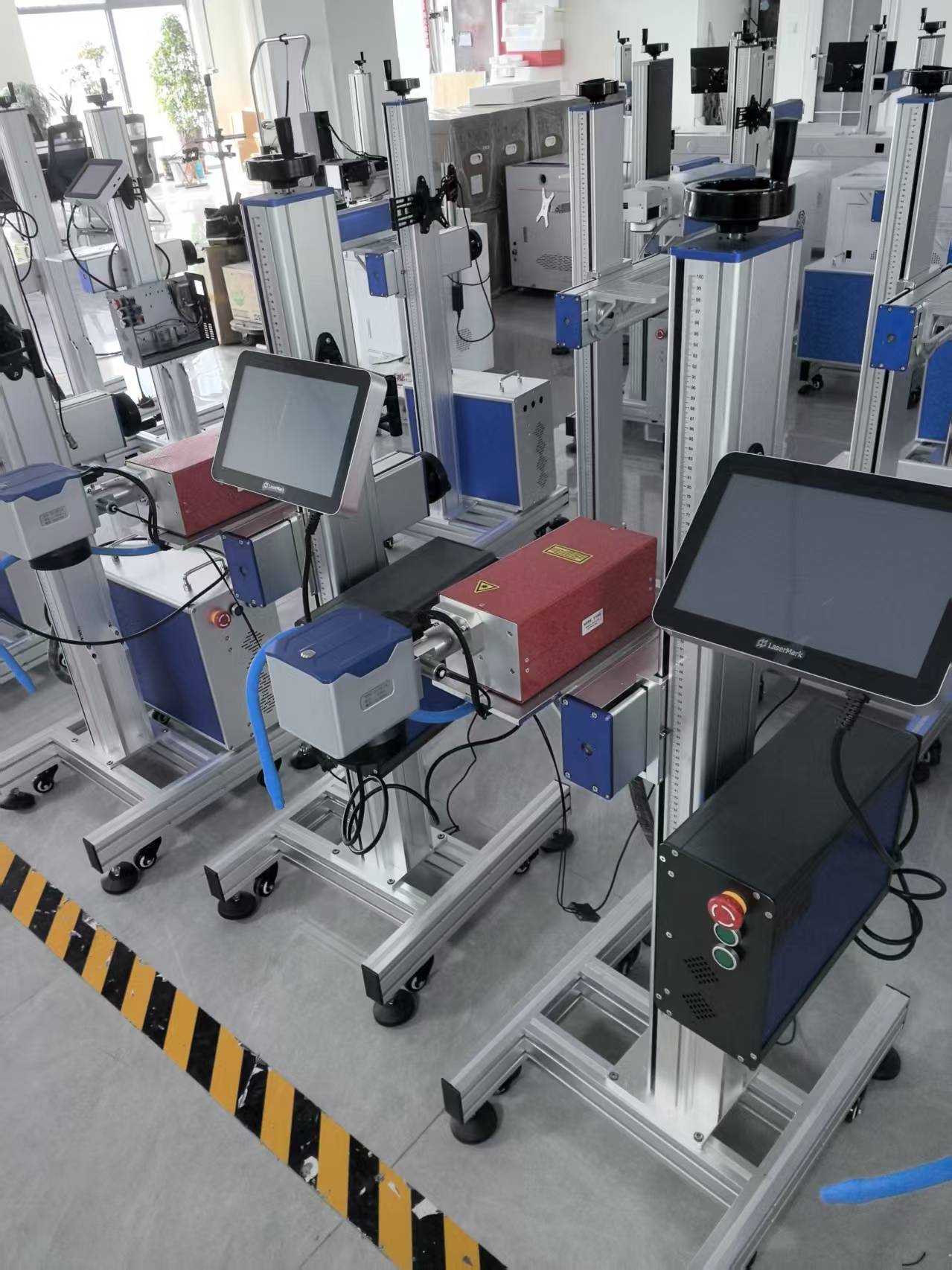
Supplier capability verification starts on the production floor: confirming that the marking process, thermal configuration and power option quoted for 24/7 duty are the ones actually assembled and tested.
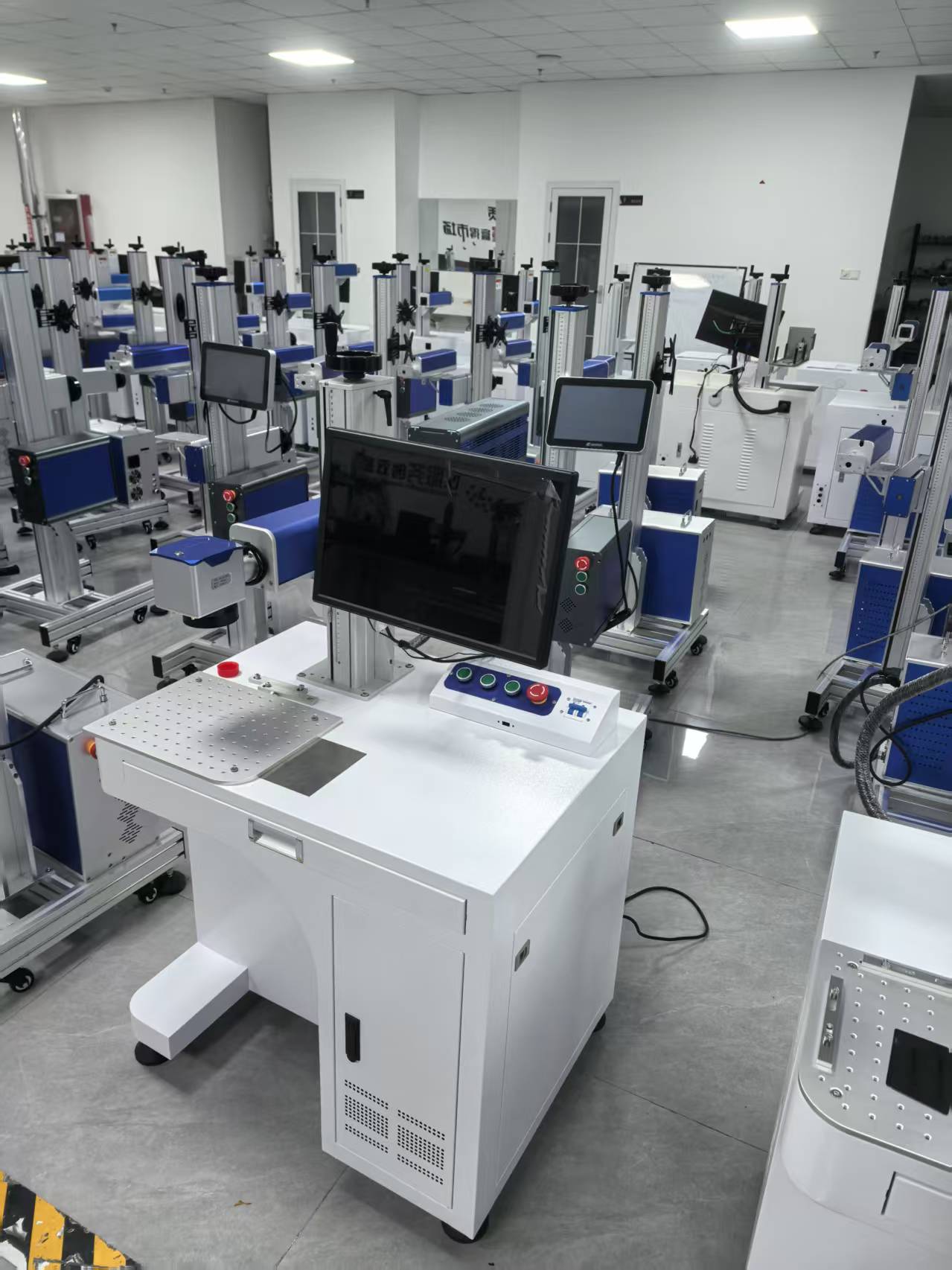
Pre-shipment testing is the point at which continuous-duty claims become verifiable: aging tests and precision calibration are performed before dispatch, not after installation.
Frequently asked questions
What safety and compliance evidence should a Portable Laser Marking Machine supplier provide before a 24/7 deployment?
Four document sets should be requested. First, laser safety: a Class 4 laser safety enclosure with an anti-radiation observation window, a safety door interlock switch that cuts laser emission immediately when the enclosure is opened, an emergency stop button, and certified OD5+ anti-laser protective eyewear. Second, electrical safety: overload protectors, residual current circuit breakers (RCCB) and reliable grounding protection. Third, pre-shipment testing: a 72-hour continuous full-load aging test and insulation withstand voltage testing, plus precision calibration. Fourth, market compliance: CE, FDA and ISO documentation, with hand-held units assessed against EN ISO 11553-2 and US-bound laser products following FDA 21 CFR Subchapter J Parts 1000 through 1005. Jinan Yuanshida states that its machines comply with CE, FDA and ISO standards and are designed to meet certification and customs clearance requirements in many countries.
Can a portable laser marking machine really run continuous multi-shift production on hardware parts?
It can, provided the process and thermal design are specified for it rather than assumed. The marking process is consumable-free, so production does not stop for ink, chemical or cutting-bit replacement. Heat is handled either by air cooling or by an external industrial cooling option, and handheld models can run from a built-in lithium battery or a DC 20V supply such as a power bank instead of a fixed socket. USB and mobile APP control keep job loading inside the workflow. Jinan Yuanshida supplies handheld, bench-top, desktop and precision laser marking machines used in hardware and auto parts, pipes and profiles, electronic components, jewelry and accessories, mechanical parts, gifts and crafts — the categories where long-term hardware parts production is typically scheduled.
What commercial terms should buyers expect when evaluating long-term Portable Laser Marking Machine suppliers?
The published purchasing terms are a minimum order quantity of 5 units, with payment structured as deposit plus balance payment. The supplier typically provides complete machines and international shipping solutions; the specific delivery term (EXW, FOB, CIF or another arrangement) should be confirmed with sales. Buyers should weigh these terms against the operating cost model rather than against unit price alone: because portable laser marking is consumable-free, it eliminates ongoing costs for varied cutter bits and tool wear that a mechanical engraving process carries, and the fixed optical path has zero mechanical wear.
How can a buyer validate a unit before committing to annual volumes?
Request the pre-shipment test evidence and a pilot unit for marking your own parts. Acceptance criteria as published are pre-shipment aging tests and precision calibration; the specific acceptance procedure — on-site acceptance, remote testing or third-party inspection — should be negotiated and confirmed with the client. Buyers should test with the largest and thinnest parts in the mix, confirming they fit the standard 110 mm × 110 mm marking area or require repositioning. Customized marking solutions and OEM/ODM configurations are available for applications where the standard platform needs adaptation.
What spare parts and after-sales support should a long-term supplier provide — and how can I send an inquiry for annual pricing?
Look for full English after-sales support, a documented export record, and a stated commitment to long-term partnership rather than a one-off transaction. Jinan Yuanshida International Trade Co., Ltd. has exported for many years to more than 80 countries and regions, serves overseas factories, distributors and trading companies, and provides standard equipment, customized marking solutions, OEM/ODM services and full English after-sales support. To request a sample unit or an annual pricing quotation, send your part drawings, materials and expected duty cycle through the contact details below, and the team will confirm configuration, acceptance procedure and delivery terms for your market.
Conclusion: buy the support, not just the unit
For a portable marking deployment running around the clock, the supplier evaluation is the product evaluation. A consumable-free marking process removes recurring consumable downtime; air-cooled or externally cooled configurations and automatic thermal shutdown protect the duty cycle; built-in lithium battery or DC 20V power keeps the unit at the workpiece; USB and mobile APP control keeps it in the workflow; and a written fiber source rating turns asset life from a claim into a planning input. Wrapped around all of that, safety hardware, a 72-hour full-load aging test, compliance documentation and English after-sales support are what make a portable laser marking machine a long-term production asset rather than a capital purchase that has to be justified again next year.
Next step: sample, quote, or annual pricing
Send your part samples, marking requirements and expected duty cycle to receive a configuration proposal, a sample validation plan and an annual pricing quotation. Catalog download: Portable Laser Marking Machine Product Catalog (PDF)
Jinan Yuanshida International Trade Co., Ltd.
Website: www.yuanlaser.com
Email: cheng@yuanlaser.com
WhatsApp / Mobile: +86 156-2882-7593
Address: Room 909, Unit 1, Building 1, Kangqiao Yidong Mansion Complex, No. 5326, Aoti Middle Road, Shunhua Road Subdistrict, Jinan Area, China (Shandong) Pilot Free Trade Zone
Contact person: Yuanyuan. Product availability, delivery terms and acceptance procedures are confirmed individually for each order.
Have Questions or Need More Details?
Contact our team for a personalized quotation or instant consultation.
Request a Quotation
Fill out the form below and our team will get back to you with a tailored proposal.
WhatsApp Direct Chat
Prefer to chat in real-time? Message us on WhatsApp for instant assistance & quick answers.
- Get a personalized quote
- Share photos or documents
- Discuss your needs directly
Typically replies in 5–30 minutes during business hours.