Handheld Fiber vs Miniature Multi-Material: Portable Laser Marking Machine Choice
Portable Laser Marking Machine · Field and Workshop Selection
Handheld Fiber vs Miniature Multi-Material: Choosing a Portable Laser Marking Machine for Field and Workshop Work
Two portable laser marking machines designed for on-site work solve the same handling problem with opposite engineering priorities. The Handheld Fiber Laser Marking Machine (Second Generation Portable Handheld Fiber Laser Marking Machine) from Jinan Yuanshida International Trade Co., Ltd. — a laser marking equipment manufacturer and exporter registered in Jinan, Shandong, China, founded in 2012 and exporting to more than 80 countries and regions — is a fibre unit of about 6 kg with a 1064 nm source, a built-in lithium battery and a Linux 7-inch touch-screen console. The Miniature Multi-Material Laser Marking Machine from the same supplier weighs 2.7 kg, switches between a 1064 nm and a 455 nm light source, and can run from a power bank over a Type-C power input.
Both are marketed as portable laser marking machines, and both are hand-carried rather than trolley-mounted. They are not interchangeable. The engineering trade-off runs along four axes — material range, optical power, working field and power autonomy — and the right answer changes depending on whether the unit will spend its life marking stainless steel flanges on a plant floor or initials on leather, wood and coloured glass in a craft studio.
Decision rule in one paragraph: choose the Handheld Fiber Laser Marking Machine when the workload is metal-dominant (stainless steel, carbon steel, aluminium, copper, iron, gold, silver, carbide, painted metal), when a 110 × 110 mm marking area is needed, and when the 20 W / 30 W / 50 W / 60 W power options matter for deeper or faster marking. Choose the 2.7 kg Miniature Multi-Material Laser Marking Machine when the same operator must mark metals alongside bamboo, wood, leather, paper, coloured glass, plastics and ceramics, when the unit has to be carried repeatedly between locations, and when a 55 × 55 mm scanning area with up to 4,000 mm/s processing speed is sufficient for the parts in question.
Problem Definition: “Portable” Describes Handling, Not Capability
Buyers shortlist portable laser marking machines by weight and then discover that weight says almost nothing about what the machine can mark. A published 2026 guide to portable laser marking machines places typical handheld and portable units in a 15 to 35 lb band, approximately 6.8 to 15.8 kg. That band describes units carried by one or two people to a workpiece; it does not describe the optical engine inside them. The Miniature Multi-Material unit at 2.7 kg sits far below that band, while the Handheld Fiber unit at about 6 kg sits inside it — yet the lighter machine has the wider material list and the heavier machine has the higher power options.
The practical problem for a buyer at research and evaluation stage is therefore a constraint-matching problem, not a ranking problem. Four constraints decide the outcome:
- Substrate constraint. Which materials must the machine mark on day one, and which materials are likely in year two?
- Field constraint. What is the largest single mark, logo or QR code the unit must produce without repositioning the workpiece?
- Energy and duty constraint. Will the unit run from its own battery all day on a site with no outlet, or from a bench supply with occasional cable-free use?
- Documentation constraint. Which market will the machine be installed in, and which conformity documents must accompany it for customs clearance and internal safety approval?
Misjudging any one of these constraints produces the two classic failure modes: a metal shop buys the lighter dual-source unit and finds the working field too small for pipe flanges, or a mixed-material studio buys the higher-power fiber unit and finds the wavelength cannot deliver a readable mark on bare wood or coloured glass.
Industry Background: Why Portable Formats Keep Expanding
The wider market context explains why both formats exist. Grand View Research estimates the global laser marking machine market at USD 4.4 billion in 2026, and reports that fiber laser technology held a 46.1% revenue share in 2025, with Asia Pacific accounting for approximately 44% of revenue. Fiber sources dominate because 1064 nm output couples efficiently into metals — the material class that dominates hardware, automotive, machinery and electronics production.
Portable and handheld formats grew out of a maintenance and traceability need rather than a production-line need: marking a serial number on an installed component, a pipe already in position, or a large weldment that cannot be moved to a benchtop machine. The product-corpus description of laser marking for these formats is consistent — a clean, precise and continuous process with zero consumables, no ink, no solvent and no label stock. That consumable-free characteristic is what makes a battery-powered unit viable in the field at all.
In parallel, a second buyer group emerged from craft, jewellery and personalised-product workshops. These users need small marks on mixed substrates — a wooden tag, a leather patch, a coated metal plate — and they value grams and portability more than watts. The dual-source miniature format is the engineering answer to that group.
Detailed Solution: How the Two Architectures Differ
Handheld Fiber Laser Marking Machine: One Wavelength, High Power, Large Field
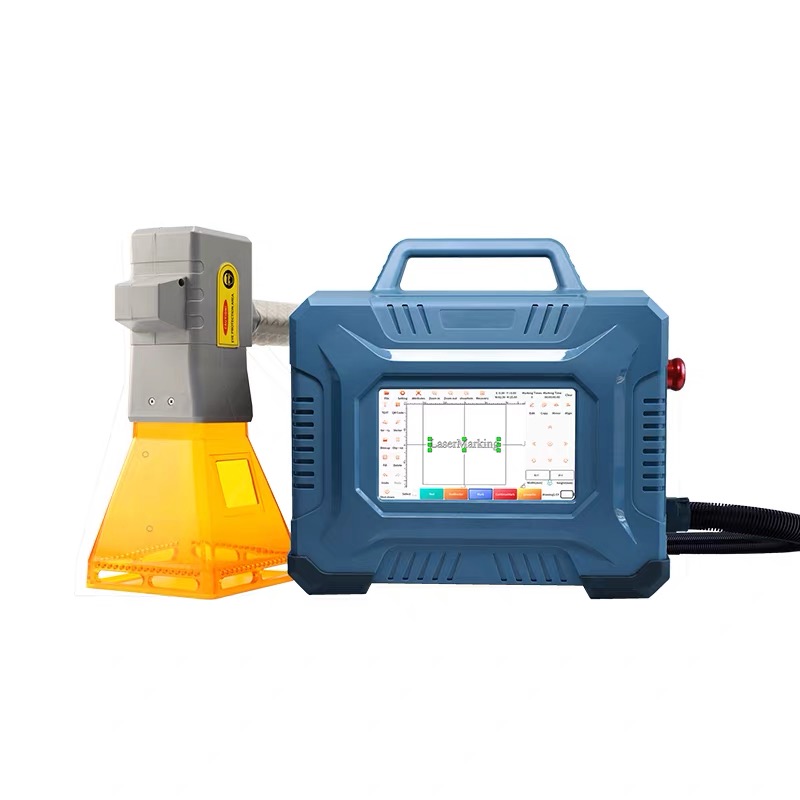
The Handheld Fiber Laser Marking Machine is a single-source fiber system. Its stated specification is a 1064 nm wavelength with laser power options of 20 W, 30 W, 50 W and 60 W, air cooling, and a marking area of 110 × 110 mm. The control layer is a Linux operating system on a 7-inch touch screen, with Bluetooth, Wi-Fi and mobile APP support. Power comes from a built-in lithium battery, and the unit also accepts a 90 V–240 V, 50/60 Hz supply. The stated laser life is approximately 100,000 hours, and the machine weighs about 6 kg.
Material coverage for this unit is metal-first: stainless steel, carbon steel, aluminium oxide, aluminium alloy, aluminium, copper, iron, gold, silver, carbide and painted metal, plus acrylic, PVC, leather and painted wood. The file-import list covers JPG, PNG, BMP, SVG, PLT, DXF, Excel, TXT, barcode and QR code, which matters in field work where artwork arrives as a phone photo or a customer-supplied vector file. Target industries named for this model include mechanical parts processing, electronic and electrical production, medical equipment, advertising signs, building materials, hardware parts, auto parts, pipes, profiles, jewellery, gifts and crafts.
Miniature Multi-Material Laser Marking Machine: Two Wavelengths, 2.7 kg, Small Field
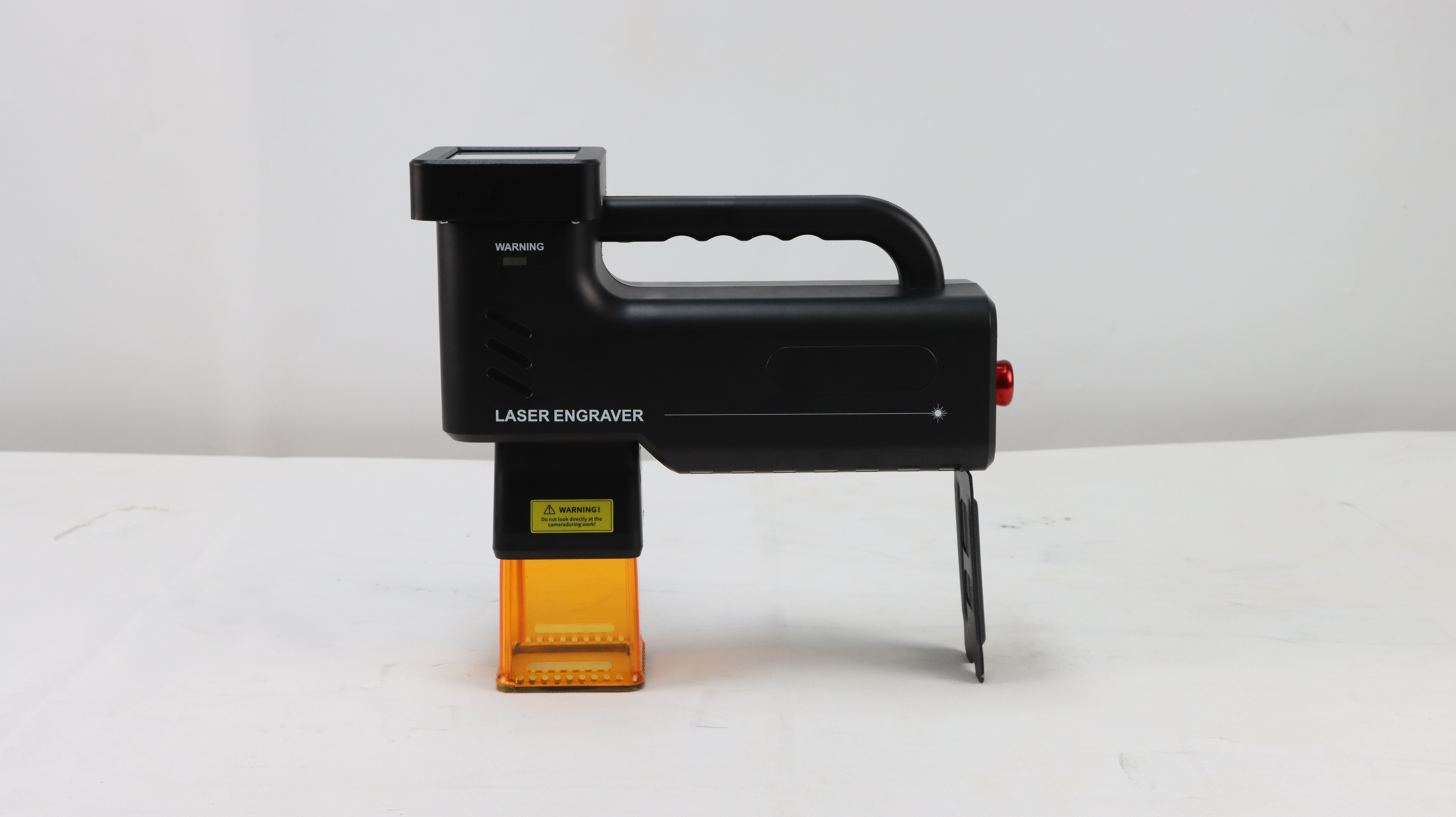
The Miniature Multi-Material Laser Marking Machine takes the opposite approach. It uses a switchable dual light source of 1064 nm and 455 nm, operating in pulse mode with a power regulation range of 25–100 in gradient steps. Overall power consumption is rated at no more than 100 W. Processing speed reaches up to 4,000 mm/s, the scene focal length is 133 mm, and the scanning area is 55 × 55 mm. The complete unit weighs 2.7 kg and is air cooled.
Its power design is deliberately consumer-infrastructure-friendly: a built-in lithium battery, a DC 20 V input that supports power bank supply, and a Type-C power interface, with a Type-A interface for data. Operation is available through a mobile app, PC software or the touch screen. The material list is the reason the machine exists: metals, bamboo and wood, leather, paper, coloured glass, plastics and ceramics. Named target industries are gifts and crafts, jewellery, customised DIY workshops and 3C electronic accessories.
The 455 nm channel is what unlocks the non-metal list — bare wood, paper, leather and coloured glass respond to the shorter wavelength in ways that a 1064 nm-only source cannot deliver with the same contrast. The trade-off is explicit: a 55 × 55 mm scanning area and a ≤ 100 W overall power envelope constrain both mark size and the deepest, fastest metal work.
Where the Specification Sheets Do Not Answer the Question
Two gaps are worth flagging before quotation, because they affect cycle-time and throughput commitments. First, the supplied handheld fiber specification does not publish a marking-speed figure; a buyer planning takt time must request that number rather than assume the 10,000 mm/s figure that appears on the supplier's desktop and benchtop fiber models. Second, the miniature unit's power regulation range of 25–100 is a percentage-style gradient, not a wattage figure, so metal-marking depth expectations should be validated on the actual part rather than derived from the ≤ 100 W envelope.
Step-by-Step Breakdown: A Six-Step Selection Sequence
- Inventory the substrates, including the awkward ones. Separate the list into metals (stainless, carbon steel, aluminium, copper, iron, gold, silver, carbide, painted or coated metal) and non-metals (bamboo, wood, leather, paper, coloured glass, plastics such as PVC and acrylic, ceramics). If non-metals are more than an occasional job, the 455 nm channel becomes a requirement rather than a bonus.
- Measure the largest mark, not the average mark. The handheld fiber unit offers 110 × 110 mm; the miniature unit offers 55 × 55 mm. If the largest logo, data plate or QR panel exceeds the miniature field, the operator either tiles the mark or moves to the larger field — and tiling changes fixture design, cycle time and repeatability.
- Match power to process, not to marketing. The handheld fiber machine offers 20 W, 30 W, 50 W or 60 W. Higher power options support heavier metal marking and faster coverage; the miniature unit's ≤ 100 W overall consumption and dual-source design prioritise material breadth and portability over metal throughput.
- Decide the energy model for the real working day. A built-in lithium battery serves both machines, but only the miniature unit accepts a DC 20 V power bank over Type-C. For all-day fieldwork away from mains power, confirm battery runtime and whether a power bank is an acceptable operational supply — battery cycle-life data is not published in the supplied specification, so request it.
- Confirm the operator workflow. The handheld fiber machine runs Linux on a 7-inch touch screen with Bluetooth, Wi-Fi and mobile APP support, which suits an operator who wants standalone marking without a laptop. The miniature unit offers mobile app, PC software and touch-screen operation with Type-A data and Type-C power, which suits a studio or service technician who already works from a phone or laptop.
- Lock the documentation and the sample before the purchase order. Verify conformity documents for the destination market, then run a sample on your own parts — not on a demonstration plate — before committing to a configuration.
Use Cases: Matching Format to Work
Handheld fiber as the metal-service default
- Hardware parts and mechanical spare parts. The 110 × 110 mm field and the 20–60 W power ladder fit part numbers, serials, batch codes and logos on machined and cast components.
- Pipes and profiles, marked in position. This is the classic on-site portable laser marking machine for large-size workpieces: the unit travels to an assembled pipe run rather than the pipe travelling to a benchtop machine.
- Electronic components and electrical production. The named industry coverage includes electronic and electrical production; the DXF and PLT import path supports drawing-driven marking.
- Jewellery in precious metals. Gold, silver and carbide appear in the material list, which suits ring and tag marking where metal contrast is the requirement.
Miniature multi-material as the mixed-substrate default
- Gifts, crafts and personalised products. Wooden tags, leather patches, paper cards and coated metal plates can be marked on one 2.7 kg unit instead of two single-purpose machines.
- Jewellery and 3C accessories. The named target industries for this model include jewellery and 3C electronic accessories, where small marking fields are normal and speed of changeover matters more than wattage.
- DIY workshops and small-batch customisation. A phone-based workflow with app, PC software and touch-screen control lowers the operational skill floor for short runs.
- Service and event work. Where the machine is carried, packed and re-deployed repeatedly, 2.7 kg versus about 6 kg is a daily operational difference, not a specification curiosity.
Where each format reaches its limit. The handheld fiber unit is documented for metals plus acrylic, PVC, leather and painted wood — bare wood, paper and coloured glass are outside its listed material set, and a buyer who needs those should not expect a 1064 nm source to cover them. The miniature unit's limits run in the other direction: a 55 × 55 mm scanning area and a ≤ 100 W overall power envelope mean large markings and heavy metal marking are better served by a higher-power fiber configuration.
Comparison Table: Handheld Fiber vs Miniature Multi-Material
| Decision factor | Handheld Fiber Laser Marking Machine | Miniature Multi-Material Laser Marking Machine |
|---|---|---|
| Light source | Single fiber source, 1064 nm | Switchable dual source, 1064 nm / 455 nm |
| Laser power | 20 W / 30 W / 50 W / 60 W options | Overall power ≤ 100 W; power regulation range 25–100, gradient adjustable |
| Machine weight | About 6 kg | 2.7 kg |
| Marking / scanning area | 110 × 110 mm | 55 × 55 mm (scene focal length 133 mm) |
| Processing speed | Not published in the supplied specification — request from supplier | Up to 4,000 mm/s |
| Cooling | Air cooling | Air cooling |
| Power supply | Built-in lithium battery; 90 V–240 V, 50/60 Hz | Built-in lithium battery; DC 20 V; power bank supported; Type-C power input |
| Control and interface | Linux system, 7-inch touch screen, Bluetooth, Wi-Fi, mobile APP | Mobile app, PC software, touch screen; Type-A (data), Type-C (power) |
| File import (handheld model) | JPG, PNG, BMP, SVG, PLT, DXF, Excel, TXT, barcode, QR code | App, PC software and touch-screen operation; file handling defined by software version |
| Materials | Stainless steel, carbon steel, aluminium oxide, aluminium alloy, aluminium, copper, iron, gold, silver, carbide, painted metal, acrylic, PVC, leather, painted wood | Metals, bamboo and wood, leather, paper, coloured glass, plastics, ceramics |
| Laser life | About 100,000 hours | Not published in the supplied specification |
| Named target industries | Mechanical parts, electronic and electrical, medical equipment, advertising signs, building materials, hardware parts, auto parts, pipes, profiles, jewellery, gifts and crafts | Gifts and crafts, jewellery, customised DIY workshops, 3C electronic accessories |
| Conformity documents in the supplier file | CE Declaration of Conformity M.2024.206.C105275 (EU) and FDA Radiological Health Electronic Submission Confirmation 2211928-000 (USA) | No separate conformity record in the supplied file — request the market-specific declaration before ordering |
Compliance Checkpoint: Documentation Is Part of the Constraint Set
For a portable laser marking machine, conformity paperwork is a procurement constraint rather than an afterthought, because the machine is a laser product and its destination market defines the applicable framework. For the United States, laser products must comply with FDA 21 CFR Subchapter J (Radiological Health), Parts 1000 through 1005. For hand-held units, EN ISO 11553-2 is the standard specifically used to assess hand-held laser processing device safety.
In the supplier's documentation set, the Handheld Fiber Laser Marking Machine carries both records. Its CE Declaration of Conformity is numbered M.2024.206.C105275, issued by UDEM International Certification Auditing Training Centre Industry and Trade Inc., covering the European Union market, issued on 2024-08-12 and valid until 2029-08-12. The listed standards are EN ISO 12100:2010, EN 60204-1:2018, EN 60825-1:2014+A11:2021, EN ISO 11553-1:2020+A11:2020, EN IEC 61000-3-2:2019+A1:2021+A2:2024, EN 61000-3-3:2013+A2:2019+A2021, EN IEC 61000-6-1:2019 and EN IEC 61000-6-3:2021. Its FDA Radiological Health Electronic Submission Confirmation is numbered 2211928-000, issued by CCTS (Shenzhen Zhongan Quality Inspection and Certification Co., Ltd) under Title 21 CFR Part 1002 for the United States market, with an issue date of 2022-11-15.
Both records are scoped to the handheld fiber laser marking machine. The dual-source miniature unit is a different product with a different optical configuration, so a buyer intending to install it in the EU or the US should request the conformity documents that apply to that specific model and market, and should verify the certificate scope wording matches the model name on the quotation and the nameplate.
Budget Logic: What Actually Moves the Quotation
Neither machine carries a list price in the supplier's published material, and quoting a single figure for a portable laser marking machine would be misleading because the configuration space is wide. What a buyer can do at evaluation stage is fix the cost drivers and compare quotations on equal terms:
- Power tier. On the handheld fiber machine, the choice between 20 W, 30 W, 50 W and 60 W is a primary cost variable and should be tied to the heaviest marking task, not to a preference for headroom.
- Single versus dual source. The dual 1064 nm / 455 nm architecture of the miniature unit is justified only by a real non-metal workload; if the job is metal-only, the money is better spent on power or field size.
- Energy and power accessories. Battery capacity, charger design and power-bank compatibility differ between the formats and affect the delivered configuration.
- Documentation package. Certification scope, market-specific declarations and translated documentation are part of the commercial offer, and a cheaper quotation that omits them is not equivalent.
- Order quantity and commercial terms. The supplier states a minimum order quantity of 5, offers OEM/ODM and customised marking solutions, and confirms specific customisation limits with sales.
- After-sales support. Full English after-sales technical support is part of the offer and should be evaluated as a cost element, not a courtesy.
Frequently Asked Questions
Does the miniature multi-material unit ship with the same CE and FDA documentation as the handheld fiber unit?
No — the conformity records in the supplier's file are scoped to the handheld model. The Handheld Fiber Laser Marking Machine holds CE Declaration of Conformity M.2024.206.C105275, issued by UDEM International Certification Auditing Training Centre Industry and Trade Inc., valid from 2024-08-12 to 2029-08-12 for the European Union market, against standards including EN ISO 12100:2010, EN 60204-1:2018, EN 60825-1:2014+A11:2021 and EN ISO 11553-1:2020+A11:2020. It also holds FDA Radiological Health Electronic Submission Confirmation 2211928-000, issued by CCTS (Shenzhen Zhongan Quality Inspection and Certification Co., Ltd) under Title 21 CFR Part 1002 for the United States market, issued 2022-11-15. Because US-bound laser products fall under FDA 21 CFR Subchapter J, Parts 1000–1005, and hand-held laser processing devices are assessed against EN ISO 11553-2, a buyer of the dual-source miniature model should request the declaration that names that exact model before placing the order.
Can the 2.7 kg miniature machine mark metal parts as well as wood and leather?
Yes. The Miniature Multi-Material Laser Marking Machine uses a switchable dual light source of 1064 nm and 455 nm, and its listed material scope covers metals, bamboo and wood, leather, paper, coloured glass, plastics and ceramics. The 1064 nm channel serves the metal work, while the 455 nm channel extends coverage to non-metal substrates such as bare wood, paper, leather and coloured glass. Practical limits come from the working envelope rather than the material list: the scanning area is 55 × 55 mm, the scene focal length is 133 mm, processing speed reaches up to 4,000 mm/s, overall power is ≤ 100 W with a 25–100 gradient regulation range, and the unit is air cooled with Type-A data and Type-C power interfaces. Validate contrast and depth on your own parts before committing to a large batch.
What drives the price difference between the two configurations?
The quotation gap comes from configuration, not from a fixed price band. For the handheld fiber machine, the laser power tier (20 W, 30 W, 50 W or 60 W) is the dominant variable, followed by battery and charger configuration, the 110 × 110 mm marking area optics, and the certification package. For the miniature unit, the cost centre is the switchable 1064 nm / 455 nm dual light source and the Type-C power-bank architecture, which is not present on single-source units. Commercial terms also move the number: the supplier states a minimum order quantity of 5, offers OEM/ODM and customised marking solutions, and includes full English after-sales technical support. Neither model publishes a list price, so compare quotations on matched power, matched accessories and matched documentation scope.
How can I test both machines on my own materials before buying?
Request a sample marking run on the actual production parts rather than on demonstration plates. For the handheld fiber model, prepare artwork as JPG, PNG, BMP, SVG, PLT, DXF, Excel, TXT, or as barcode and QR code data, since all of these are supported import formats. For the miniature unit, artwork can be driven from the mobile app, PC software or the touch screen. Ask for the sample to include the mark type you will actually run — a logo, a serial number, a 2D code — plus the substrate variant that is hardest to mark, such as coated metal or coloured glass. The supplier states that all equipment undergoes multiple aging tests and precision calibration before delivery, and OEM/ODM options are confirmed with sales on a case-by-case basis.
What is the lead time, and how do I start a quote?
Lead time is set by factory scheduling according to order volume, so it should be confirmed against your required delivery date at the quotation stage rather than assumed. Machines for international shipment are classified under HS code 845611, the primary classification for machine tools operated by laser processes, and the supplier states compliance with international quality standards such as CE, FDA and ISO to support certification and customs clearance. Both formats are exported to markets including Vietnam, Thailand, Malaysia, Türkiye, the United States, Poland and the Middle East. To move from evaluation to a quotation, send your substrate list, largest mark dimensions, required power tier and destination market — the next practical step is a sample test on your own parts, which you can start by contacting the supplier through yuanlaser.com or by emailing cheng@yuanlaser.com.
Conclusion: Choose the Constraint You Cannot Change
The two machines are not competing for the same purchase. The Handheld Fiber Laser Marking Machine is the higher-power, larger-field, metal-first option: 1064 nm, 20 W to 60 W, 110 × 110 mm, Linux on a 7-inch touch screen, built-in lithium battery, about 6 kg, and a documentation set that already includes CE M.2024.206.C105275 and FDA 2211928-000. The Miniature Multi-Material Laser Marking Machine is the portability-and-breadth option: 2.7 kg, switchable 1064 nm / 455 nm, up to 4,000 mm/s, 55 × 55 mm scanning area, power-bank-capable over Type-C, and a material list that reaches wood, paper, leather, coloured glass, plastics and ceramics.
The reliable way to decide is to identify the constraint you cannot engineer around. If the parts will not fit a 55 × 55 mm field, or if the metal work demands more than a ≤ 100 W envelope, the decision is already made. If the operator must carry the unit daily and the substrate list genuinely spans wood, leather, glass and metal, the lighter dual-source machine is the correct tool, and the extra power of the fiber unit would be capacity the workshop never uses.
Next step: test both formats on your own parts
Send your substrate list, largest mark size and destination market to Jinan Yuanshida International Trade Co., Ltd. and request a sample marking run or a configuration-specific quotation for the Handheld Fiber Laser Marking Machine or the Miniature Multi-Material Laser Marking Machine.
Email: cheng@yuanlaser.com | Mobile / WhatsApp: +86 156-2882-7593 | Web: www.yuanlaser.com
Have Questions or Need More Details?
Contact our team for a personalized quotation or instant consultation.
Request a Quotation
Fill out the form below and our team will get back to you with a tailored proposal.
WhatsApp Direct Chat
Prefer to chat in real-time? Message us on WhatsApp for instant assistance & quick answers.
- Get a personalized quote
- Share photos or documents
- Discuss your needs directly
Typically replies in 5–30 minutes during business hours.