Portable Laser Marking Machine Wavelengths Explained: 355 nm UV, 1064 nm Fiber, and 455 nm Blue
Wavelength determines what a portable laser marking machine can mark, and what it will damage. Three configurations cover most evaluation cases in this equipment category: a 355 nm UV source used for cold marking on plastics, packaging and heat-sensitive materials; a 1064 nm fiber source used for metals and general industrial marking; and a dual 1064/455 nm source that switches between two optical profiles for multi-material work. Choosing the wrong one is usually discovered after a sample part has been rejected.
This article is written for buyers at the evaluation stage who already know they want an on-site or compact marking unit and now have to decide which optical source to specify. It explains each wavelength, ranks the three configurations by use-case fit, provides a parameter-level comparison table, and closes with the compliance, capability, budget, sample and lead-time questions that typically appear before a purchase order.
The Real Selection Problem: Wavelength Filters the Material List Before Power Does
Most evaluation spreadsheets start with laser power, machine weight and price. Wavelength appears somewhere in the specification block and is treated as a technical footnote. In practice it is the first elimination filter, because absorption — not wattage — determines whether the beam couples into the surface at all, and how much of that energy becomes heat in the substrate.
Three failure patterns appear repeatedly when wavelength is chosen last:
- Thermal damage on thin or heat-sensitive substrates. A 1064 nm fiber source delivers energy that many films, painted plastics and packaging surfaces convert into localized heat. The result is distortion, discoloration or a mark that fails a downstream inspection step.
- Insufficient depth or contrast on thick metal. A low-power UV source on heavy bare steel will not produce the depth or contrast a metal marking job expects, even if the mark is visually acceptable on a polished sample.
- Wrong channel on a dual-source unit. A 1064/455 nm unit is capable of both profiles, but running the material on the mismatched channel produces weak contrast even though the machine is functioning correctly.
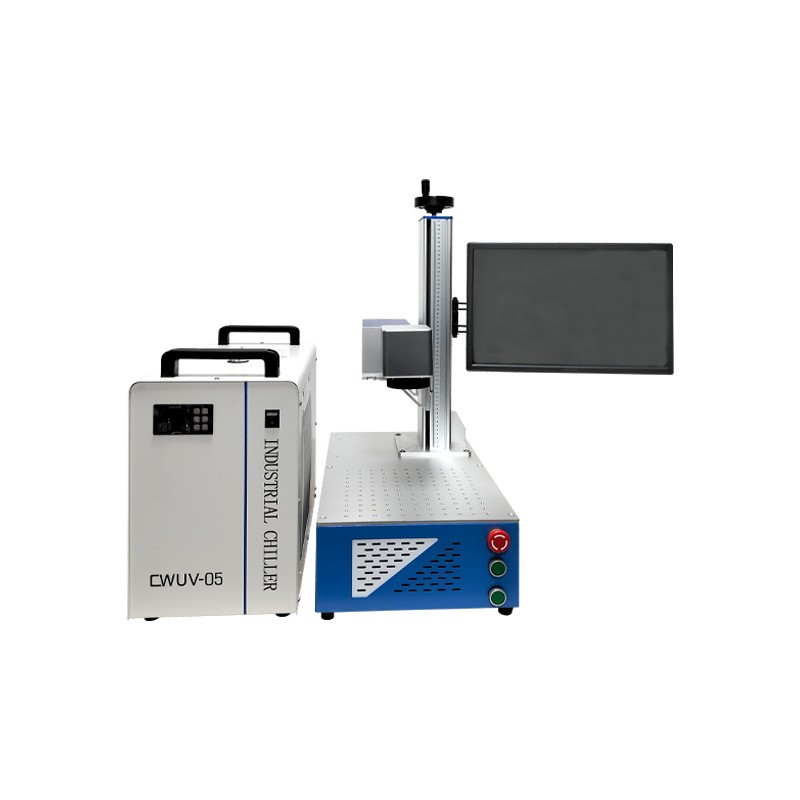
Definition used in this article: "portable" covers two different physical formats. The first is a handheld or on-site unit with a built-in lithium battery and an air-cooled marking head. The second is a compact unit light enough to move between cells. Third-party guidance puts handheld and portable laser marking units typically at 15 to 35 lbs (approximately 6.8 to 15.8 kg), while compact units can sit well below that — the dual-source unit described below weighs 2.7 kg. The 355 nm UV machine in this line-up is built as a desktop-format unit with an external industrial water chiller, which is a real constraint for field work and should be evaluated as such.
Industry Background: Why Wavelength Selection Is a 2026 Procurement Question
Laser marking is a mature category, but the portable and multi-material segment is where specification decisions have become more complicated. The global laser marking machine market is estimated at USD 4.4 billion in 2026, according to Grand View Research (published 15 July 2026). Fiber laser technology held a revenue share of 46.1% in 2025, and Asia Pacific accounted for approximately 44% of revenue in 2025 — which explains why fiber remains the default assumption in most buyer conversations and why alternative sources need an explicit justification.
Two regulatory layers sit on top of the technical choice:
- United States: laser products sold in the USA must comply with FDA 21 CFR Subchapter J (Radiological Health), Parts 1000 through 1005.
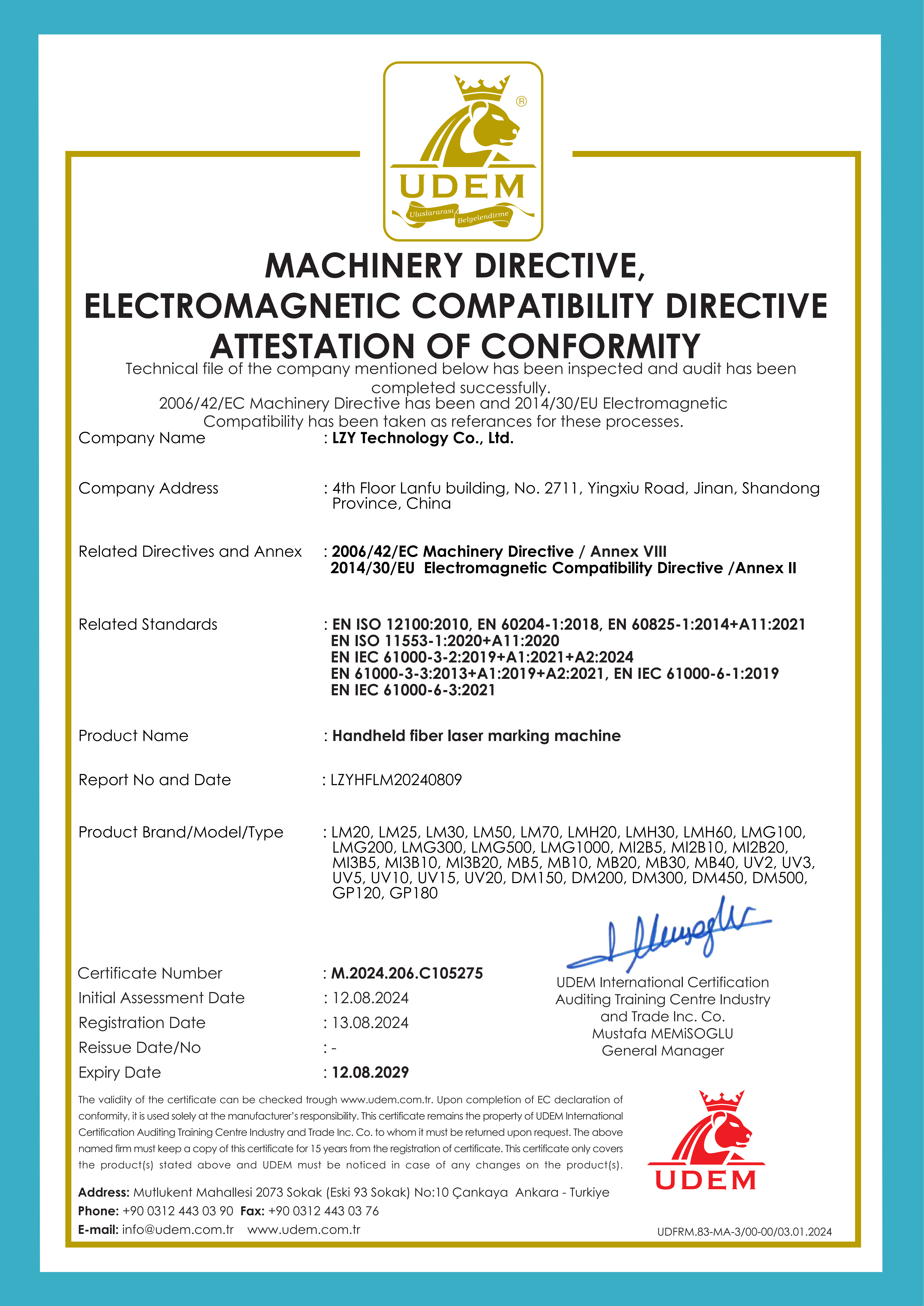
- European Union and international: portable laser markers are specifically assessed against EN ISO 11553-2 for hand-held safety. The CE Declaration of Conformity for the handheld fiber model in this line-up references EN ISO 12100:2010, EN 60204-1:2018, EN 60825-1:2014+A11:2021, EN ISO 11553-1:2020+A11:2020 and the EMC series EN IEC 61000-3-2, EN 61000-3-3, EN IEC 61000-6-1 and EN IEC 61000-6-3.
For importers, HS Code 845611 is the primary classification for machine tools operated by laser processes in international trade, and it is the code that usually appears on the customs documentation for these units.
Detailed Solution: The Three Wavelength Configurations
355 nm UV: Cold Marking for Heat-Sensitive Substrates
The 355 nm UV laser marking machine uses a short-wavelength source that is absorbed at the surface of the substrate rather than driven deep into it, which is why it is described as cold processing. Its documented specification is a 3 W or 5 W source with a pulse width of less than 60 ns, a modulation frequency of 30 to 100 kHz, beam quality M2 below 1.5 in single mode, a marking speed of up to 10,000 mm/s, a 110 mm × 110 mm marking area, a maximum marking depth below 0.4 mm, a minimum line width of 0.4 mm or less, a minimum character of 0.15 mm, repeatability of ±0.001 mm, 140+ font libraries with custom fonts addable on request, overall power below 400 W, an operating voltage of 110 V to 240 V and a standard USB control interface. Cooling is handled by an external industrial water chiller (DWUV-05 included).
The material list is dominated by polymers and packaging: PE plastics, PVC plastics, metal parts, building materials, glass, film, packaging and composite materials. The typical industries are food and beverage packaging, pharmaceuticals, daily chemicals, cosmetics, electronics, hardware, steel and cement production lines. In case documentation for this product family, UV cold-processing is highlighted specifically for its advantage on heat-sensitive substrates, with zero thermal damage reported on sensitive components.
1064 nm Fiber: The Metal and Industrial Default
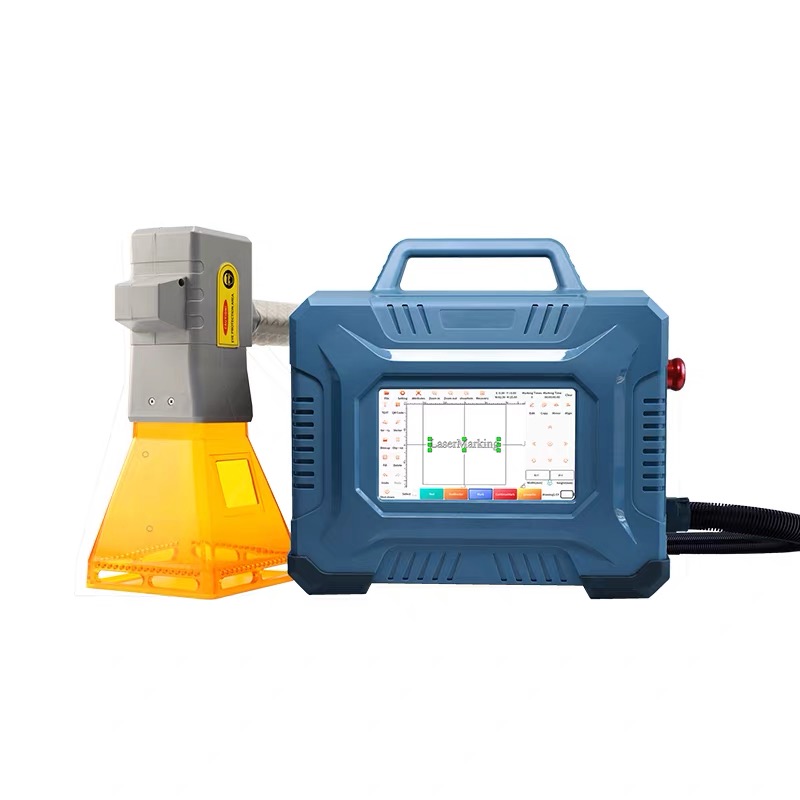
The handheld fiber configuration is a 1064 nm source available at 20 W, 30 W, 50 W or 60 W, air cooled, running a Linux system on a 7-inch touch screen with Bluetooth, WiFi and mobile app support, a built-in lithium battery, a laser life of about 100,000 hours, a 90 V to 240 V 50/60 Hz power supply and a 110 mm × 110 mm marking area.
Its material coverage explains why 1064 nm remains the industrial default: stainless steel, carbon steel, aluminum oxide, aluminum alloy, aluminum, copper, iron, gold, silver, carbide, painted metal, acrylic, PVC, leather and painted wood. Applicable industries are mechanical parts processing, electronic and electrical production, medical equipment, advertising signs, building materials, hardware parts, auto parts, pipes, profiles, jewelry, gifts and crafts.
Where depth is the requirement, the benchtop fiber format in the same family reaches a maximum marking depth of up to 4 mm with a 150 mm × 150 mm maximum marking area and a marking speed of up to 10,000 mm/s, while the desktop fiber format extends to a 100 W option with a standard 110 mm × 110 mm area and optional 150 mm, 175 mm or 200 mm areas. For flat-part production cells that need depth rather than portability, these are the relevant reference points.
1064/455 nm Dual-Source: One Unit, Two Optical Profiles
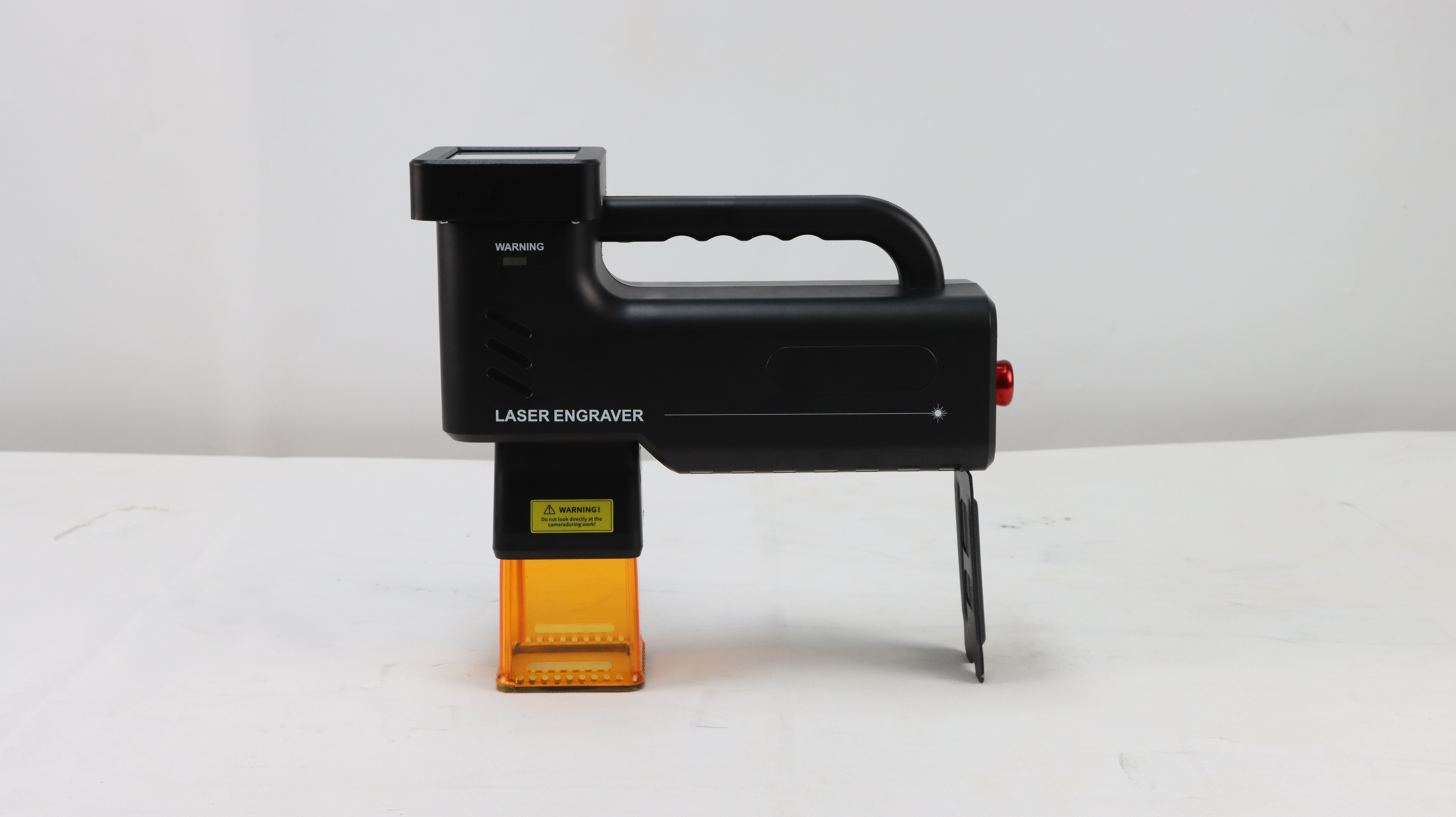
The miniature multi-material unit carries two switchable light sources at 1064 nm and 455 nm. Its documented specification is pulse operation, a power regulation range of 25 to 100 in gradient steps, a processing speed of up to 4,000 mm/s, a scene focal length of 133 mm, a machine weight of 2.7 kg, a power supply of built-in lithium battery or DC 20 V with power bank support, overall power of 100 W or less, air cooling, operation through mobile app, PC software or touch screen, TYPE-A for data and TYPE-C for power, and a scanning area of 55 mm × 55 mm.
The material list is broader in variety but narrower in thickness: metals, bamboo and wood, leather, paper, colored glass, plastics and ceramics. Typical industries are gifts and crafts, jewelry, custom DIY workshops and 3C electronic accessories. The value of the dual-source design is that a workshop handling mixed materials does not have to commit to a single absorption profile, but the 55 mm × 55 mm scanning area is the constraint that decides whether that flexibility is usable for a given part.
Ranked Shortlist: Which Wavelength Fits Which Evaluation
The three configurations are ranked below by breadth of use-case fit for a general industrial evaluation. The ranking changes if the binding constraint is heat sensitivity rather than material range — that condition is stated explicitly for each entry.
Rank 1 — 1064 nm Fiber (Best Overall Fit for Metal-First Industrial Work)
This is the configuration with the widest documented material list that includes ferrous and non-ferrous metals, plus acrylic, PVC, leather and painted wood. Selection metrics: 20 W to 60 W power range, 110 mm × 110 mm marking area, air cooling, built-in lithium battery, Linux touch screen with Bluetooth, WiFi and mobile app, and a laser life of about 100,000 hours. It is also the model in this documentation set with a CE Declaration of Conformity on record (M.2024.206.C105275, issued 12 August 2024, valid to 12 August 2029) and an FDA Radiological Health Electronic Submission Confirmation on record (2211928-000, issued 15 November 2022, under Title 21 CFR Part 1002).
Ranking condition: it drops behind UV when the substrate cannot tolerate the thermal load of a 1064 nm beam.
Rank 2 — 355 nm UV (Best Fit Where Heat Damage Is the Binding Constraint)
Selection metrics: 3 W or 5 W source, pulse width below 60 ns, M2 below 1.5 in single mode, 110 mm × 110 mm marking area, maximum depth below 0.4 mm, minimum character 0.15 mm, repeatability ±0.001 mm, and 140+ font libraries. It is the correct first choice for PE and PVC plastics, film, packaging, glass, composites and heat-sensitive components, and for the packaging, pharmaceutical, cosmetics and daily chemical lines listed in its industry scope.
Ranking condition: the external industrial water chiller (DWUV-05) and the desktop format mean this is not a battery-operated field unit, so it ranks second for pure portability even though it ranks first for substrate safety.
Rank 3 — 1064/455 nm Dual-Source (Best Fit for Mixed, Small, Light Parts)
Selection metrics: 2.7 kg machine weight, overall power of 100 W or less, processing speed up to 4,000 mm/s, 133 mm scene focal length, 55 mm × 55 mm scanning area, battery or DC 20 V power with power bank support, and app, PC software or touch-screen control. It is the strongest option for gifts and crafts, jewelry, custom DIY workshops and 3C electronic accessories, where material variety inside one workshop is normal and part size is small.
Ranking condition: it moves up when the buyer cannot justify two separate machines, and moves down when any part exceeds the 55 mm × 55 mm scanning area.
Step-by-Step: Selecting a Wavelength for a Specific Part
- Classify the substrate first, not the machine. Separate the part list into metals, polymers and packaging, glass and ceramics, and coated or painted surfaces. Wavelength follows this classification, not the other way round.
- Test for thermal sensitivity. If the part is a thin film, a painted plastic housing, a packaging surface or a populated electronic assembly, treat 355 nm UV as the default candidate and 1064 nm fiber as the one that needs sample proof.
- Compare required feature size with the marking area. The UV and handheld fiber configurations both offer 110 mm × 110 mm; the dual-source unit offers 55 mm × 55 mm. A part that exceeds the scanning area cannot be marked in one pass regardless of wavelength.
- Define the depth requirement. The UV configuration is specified below 0.4 mm maximum marking depth, the desktop fiber format reaches 0.4 mm, and the benchtop fiber format reaches up to 4 mm. If the mark must survive aggressive wear, depth becomes a wavelength-and-format decision together.
- Confirm the power situation on site. A built-in lithium battery with a 90 V to 240 V supply covers handheld fiber work; the dual-source unit accepts DC 20 V including a power bank; the UV unit needs mains power plus chiller capacity.
- Match the cooling method to the duty cycle. Air cooling covers the fiber and dual-source units. The UV unit depends on an external industrial water chiller, which has to be planned into the workstation layout.
- Verify the compliance documents for the destination market. Check that the certificate scope actually names the model being purchased — the CE and FDA records in this set are scoped to the handheld fiber laser marking machine — and confirm the HS Code 845611 classification with the freight forwarder.
- Validate on a real sample before committing. Mark the actual production part, at the actual feature size, and inspect contrast, depth, edge quality and readability with the scanner used downstream.
Use Cases: Mapping Wavelength to the Job
Hardware Parts and Mechanical Spare Parts
Fasteners, brackets, machined housings and spare parts are metal-first work, which points to the 1064 nm fiber configuration at 20 W to 60 W with a 110 mm × 110 mm area. Where parts are too large or too awkward to bring to a bench, the handheld format with a built-in lithium battery and air cooling keeps the marking operation at the workpiece instead of moving the workpiece to the machine.
Pipes and Profiles — On-Site Work on Large Workpieces
Pipes, profiles and assembled structures cannot be carried to a marking station. The handheld 1064 nm configuration is designed for this pattern: battery power, air cooling, a touch screen interface and a 110 mm × 110 mm marking area that travels to the workpiece. Pipes, profiles and building materials all appear in the documented industry scope of the fiber configuration.
Electronic Components
Electronic and electrical production appears in the industry scope of the fiber configuration, while UV cold processing is documented for its advantage on heat-sensitive substrates with zero thermal damage reported on sensitive components. For populated boards and thin housings, the decision usually comes down to a sample test comparing contrast against thermal risk.
Jewelry and Gifts & Crafts
Jewelry appears in the scope of both the fiber and the dual-source configurations. The dual-source unit is the more natural fit for a workshop that moves between metals, bamboo and wood, leather, paper, colored glass, plastics and ceramics in the same week, provided the artwork fits inside 55 mm × 55 mm.
Multi-Material Job Shops and DIY Workshops
A cell that marks metal fixtures in the morning and leather or wood items in the afternoon needs either two machines or a switchable source. The dual-source 1064/455 nm unit exists for this case: 2.7 kg, 100 W or less overall power, up to 4,000 mm/s processing speed, and control through mobile app, PC software or touch screen.
Packaging, Pharmaceuticals and Cosmetics
PE and PVC plastics, film, packaging, glass and composite materials, plus the food and beverage, pharmaceutical, daily chemical and cosmetics production lines in the UV configuration's scope, define the other end of the portfolio. Here the constraint is not depth but the absence of thermal damage, which is exactly what a 355 nm cold-marking source is specified to deliver.
Comparison Table: 355 nm UV vs 1064 nm Fiber vs 1064/455 nm Dual-Source
| Parameter | 355 nm UV Laser Marking Machine | Handheld Fiber Laser Marking Machine | Miniature Multi-Material (dual-source) |
|---|---|---|---|
| Wavelength | 355 nm | 1064 nm | 1064 nm / 455 nm, switchable |
| Laser power | 3 W / 5 W (optional) | 20 W / 30 W / 50 W / 60 W | Power regulation 25–100, gradient adjustable |
| Pulse width | Less than 60 ns | Not stated in this specification set | Pulse operation mode |
| Cooling | External industrial water chiller (DWUV-05 included) | Air cooling | Air cooling |
| Marking / scanning area | 110 mm × 110 mm | 110 mm × 110 mm | 55 mm × 55 mm |
| Marking speed | Up to 10,000 mm/s | Not stated in this specification set | Up to 4,000 mm/s |
| Max. marking depth | Less than 0.4 mm | Not stated in this specification set | Not stated in this specification set |
| Min. character / line width | 0.15 mm / ≤0.4 mm | Not stated in this specification set | Not stated in this specification set |
| Repeatability | ±0.001 mm | Not stated in this specification set | Not stated in this specification set |
| Power supply | 110 V – 240 V, standard USB control | 90 V – 240 V, 50/60 Hz, built-in lithium battery | Built-in lithium battery / DC 20 V (power bank supported) |
| Control and interface | Standard USB | Linux, 7-inch touch screen, Bluetooth, WiFi, mobile APP | Mobile app, PC software, touch screen; TYPE-A data, TYPE-C power |
| Machine weight | Not stated in this specification set | Not stated in this specification set | 2.7 kg |
| Overall power | Less than 400 W | Not stated in this specification set | 100 W or less |
| Documented materials | PE, PVC, metal parts, building materials, glass, film, packaging, composite materials | Stainless steel, carbon steel, aluminum oxide, aluminum alloy, aluminum, copper, iron, gold, silver, carbide, painted metal, acrylic, PVC, leather, painted wood | Metals, bamboo and wood, leather, paper, colored glass, plastics, ceramics |
| Documented industries | Food and beverage packaging, pharmaceuticals, daily chemicals, cosmetics, electronics, hardware, steel, cement | Mechanical parts, electrical, medical equipment, advertising signs, building materials, hardware, auto parts, pipes, profiles, jewelry, gifts and crafts | Gifts and crafts, jewelry, custom DIY workshops, 3C electronic accessories |
| Compliance records in this set | Not included for this model in the records used here | CE M.2024.206.C105275 (valid to 2029-08-12); FDA submission confirmation 2211928-000 | Not included for this model in the records used here |
Where a field reads "not stated in this specification set", the specification should be requested directly for the exact model being quoted rather than inferred from another format in the family.
Frequently Asked Questions
Are these portable laser marking machines certified for the EU and the US markets?
For the handheld fiber laser marking machine, the documentation set includes a CE Declaration of Conformity numbered M.2024.206.C105275, issued by UDEM International Certification Auditing Training Centre on 12 August 2024 and valid to 12 August 2029, referencing EN ISO 12100:2010, EN 60204-1:2018, EN 60825-1:2014+A11:2021, EN ISO 11553-1:2020+A11:2020 and the EN IEC 61000 EMC series. The same model has an FDA Radiological Health Electronic Submission Confirmation numbered 2211928-000, issued 15 November 2022 under Title 21 CFR Part 1002. In the USA, laser products must comply with FDA 21 CFR Subchapter J, Parts 1000 through 1005, and portable hand-held markers are assessed against EN ISO 11553-2 in the EU and international context. Buyers should confirm that the certificate scope names the exact model and wavelength being purchased, since the records above are scoped to the handheld fiber machine.
Can one portable laser marking machine handle both metal and plastic parts?
Yes, within limits. The dual-source unit switches between a 1064 nm and a 455 nm light source, and its documented material list covers metals, bamboo and wood, leather, paper, colored glass, plastics and ceramics. The limits are physical rather than optical: the scanning area is 55 mm × 55 mm, overall power is 100 W or less, and processing speed is up to 4,000 mm/s. A buyer with larger metal parts should compare against the 1064 nm fiber configuration, which offers a 110 mm × 110 mm marking area and 20 W to 60 W of power, but does not carry the second source. The practical answer comes from marking the actual parts on both configurations.
What drives the cost difference between UV, fiber and dual-source configurations?
The cost structure differs by architecture rather than by brand. The UV configuration pairs a 3 W or 5 W short-pulse source (pulse width below 60 ns) with an external industrial water chiller (DWUV-05), so the system includes cooling hardware that the air-cooled units do not need. The handheld fiber configuration integrates a 20 W to 60 W source, air cooling and a built-in lithium battery in one body, with a laser life of about 100,000 hours. The dual-source unit packages two switchable sources into a 2.7 kg body at 100 W or less overall power. Commercial terms should be quoted per configuration: the published minimum order quantity is 5 units, and lead time is set by factory scheduling by order volume rather than by a fixed catalogue date.
Can we test our own parts before placing an order?
Sample validation is the only reliable way to confirm wavelength fit, because absorption behaviour on a real production surface cannot be predicted from a material name alone. The practical test sequence is to mark the actual part at the actual feature size on the candidate configuration, then inspect contrast, depth, edge quality and scanner readability. Jinan Yuanshida International Trade Co., Ltd supports customized marking solutions and OEM/ODM services, and specific sample arrangements, customization options and their limits should be confirmed directly with sales before the test is scheduled. All machines undergo aging tests and precision calibration before delivery, and quality control follows documented pre-shipment inspection procedures.
What is the lead time and how is delivery handled?
Lead time is governed by factory scheduling by order volume, with a published minimum order quantity of 5 units, so the schedule should be confirmed against the specific configuration and quantity in the quote rather than assumed from a standard figure. Units are exported to Vietnam, Thailand, Malaysia, Turkey, the United States, Poland and Middle East regions, and full English after-sales technical support is provided for equipment supplied to export markets. To request a configuration-specific quote, a sample test or the product catalogue, contact the team at yuanlaser.com, by email at cheng@yuanlaser.com, or via WhatsApp at +86 156-2882-7593.
Conclusion: Choose the Wavelength From the Part, Then the Format From the Workflow
The three configurations are not three grades of the same machine — they are three different answers to the question of how much energy a substrate can absorb without being damaged. The 355 nm UV source is the cold-marking answer for plastics, film, packaging, glass and heat-sensitive components, at 3 W or 5 W, below 60 ns pulse width, with a 110 mm × 110 mm area and an external water chiller. The 1064 nm fiber source is the metal-and-industrial answer, at 20 W to 60 W, air cooled, battery powered, with a 110 mm × 110 mm area and documented CE and FDA records on the handheld model. The 1064/455 nm dual-source unit is the mixed-material answer for small, light parts, at 2.7 kg and 55 mm × 55 mm.
A workable evaluation order is therefore: classify the substrate, confirm the required feature size and depth, check the power and cooling that the workstation can support, verify the compliance documents name the exact model, and then validate on real samples. Performing those five steps in that order removes most of the risk that a wavelength decision creates downstream.
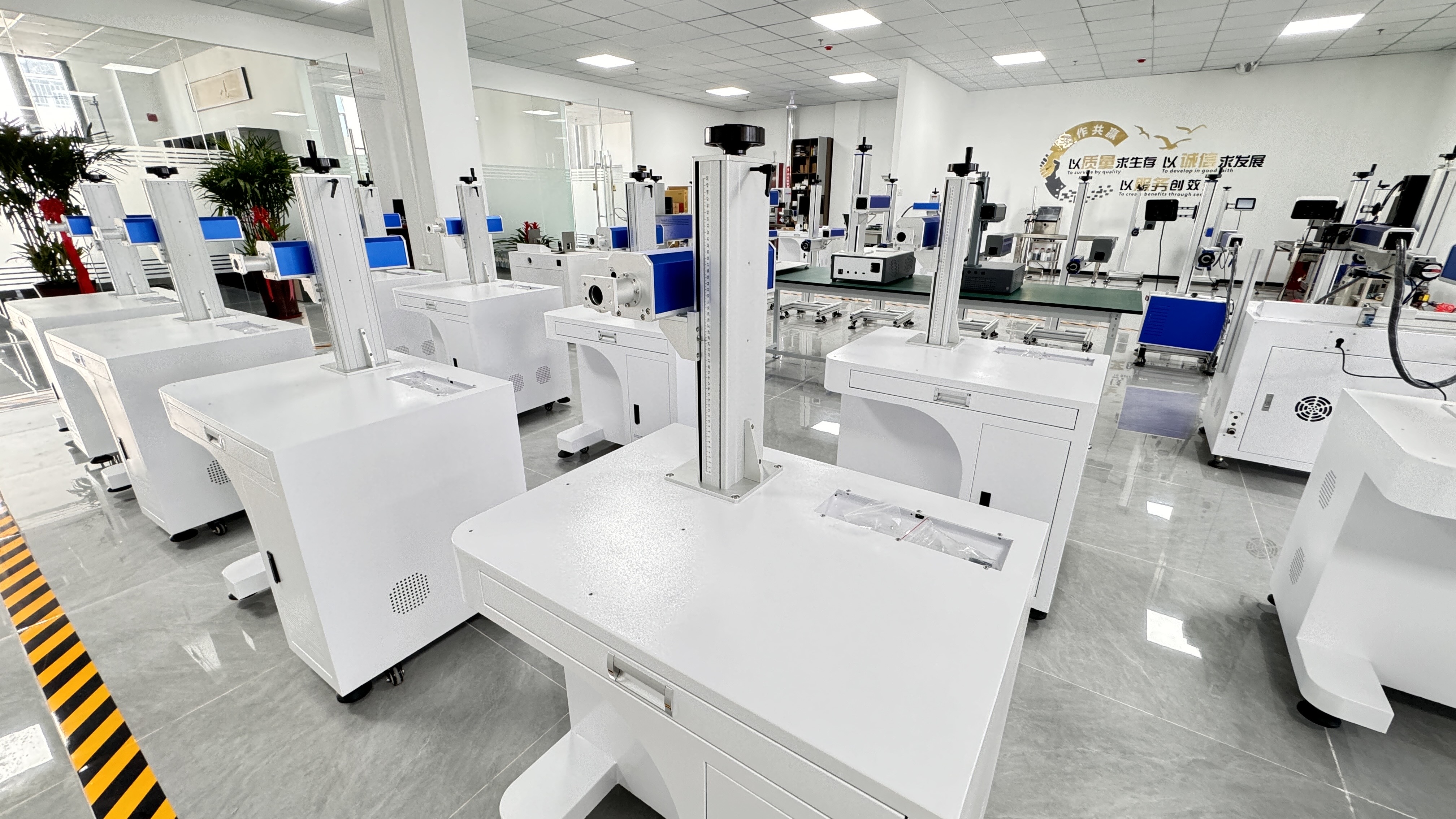
Next step: match a wavelength to your part list. Jinan Yuanshida International Trade Co., Ltd is a Jinan-based supplier of handheld, benchtop and desktop laser marking equipment, exporting to more than 80 countries and regions. Request the full catalogue, download the product brochure, or send a sample part for a wavelength comparison.
Download the product brochure (PDF) | WhatsApp: +86 156-2882-7593 | www.yuanlaser.com
Have Questions or Need More Details?
Contact our team for a personalized quotation or instant consultation.
Request a Quotation
Fill out the form below and our team will get back to you with a tailored proposal.
WhatsApp Direct Chat
Prefer to chat in real-time? Message us on WhatsApp for instant assistance & quick answers.
- Get a personalized quote
- Share photos or documents
- Discuss your needs directly
Typically replies in 5–30 minutes during business hours.