Portable Laser Marking Machine: UV Cold Marking for Food, Pharma, and Cosmetic Packaging
Answer first: a portable laser marking machine can be deployed on food and beverage, pharmaceutical, and daily chemical or cosmetic packaging lines, but only when the marking process is matched to the packaging substrate. The deciding variable is wavelength, not footprint. Heat-sensitive PE, PVC, film, glass, and composite packaging can deform, discolour, or burn under thermal marking, while a 355 nm UV cold laser with a pulse width under 60 ns alters the surface photochemically rather than by heat. Jinan Yuanshida International Trade Co., Ltd., a Jinan-based supplier of industrial laser marking equipment, offers portable handheld and desktop laser marking configurations that can be adapted to these packaging lines.
What Makes Food, Pharma, and Cosmetic Packaging Hard to Mark
The hardest packaging-marking problem is not printing a logo. It is applying permanent, legible, scannable codes, including variable text, batch codes, and date codes, to heat-sensitive packaging at line speed without damaging the package or the product inside it.
Four pressures collide on a single packaging line:
- Substrate sensitivity. PE and PVC bottles, thin films, glass containers, and composite laminates respond differently to heat. A thermal process can deform thin film, discolour PVC, or introduce micro-cracks in glass.
- Code content. Modern packaging carries variable text, brand logos, 1D barcodes, 2D codes, batch numbers, and date codes. Every element has to be readable, durable, and traceable through the supply chain.
- Character density. Regulatory and retail requirements push character sizes down. A minimum character size of 0.15 mm becomes necessary when the available print field on the package is small.
- Throughput and uptime. Packaging lines run continuously. Any marking step that requires constant consumable changeovers, or that has to be stopped for cooling, turns into a bottleneck.
Inkjet and thermal-transfer systems cover part of this ground, but they consume ink, ribbons, and solvents, and they introduce either contact or wet chemistry to the package surface. Laser marking removes the consumable from the equation entirely. The remaining question is which laser, and whether that laser is gentle enough for the substrate in front of it.
Industry Background: Why Packaging Lines Are Moving Toward Laser and Cold-Processing Marking
Laser marking is a large and still-expanding industrial category. Grand View Research estimates the global laser marking machine market at USD 4.4 billion in 2026, with a forecast window running to 2033. Within that market, fiber laser technology held a 46.1% revenue share in 2025, and Asia Pacific accounted for approximately 44% of revenue, making it the largest single regional market.
Two structural shifts sit behind those numbers, and both matter to packaging buyers.
First, marking is moving from ink to light. Laser marking is consumable-free, meaning zero consumables in the print process: no ink to refill, no ribbon to replace, no solvent to store. That removes a class of hygiene, storage, and waste-disposal questions from the production floor, and it supports continuous, around-the-clock (24/7) production schedules without consumable changeovers.
Second, the machines themselves are moving closer to the work. Portable and handheld laser markers let a single unit be carried and repositioned between lines, cells, or stations instead of being fixed to one location. Yuanshida supplies a second-generation portable handheld fiber laser marking machine with a net weight of about 6 kg, a 110 mm x 110 mm marking area, a built-in lithium battery, and a 7-inch Linux touch screen with Bluetooth, WiFi, and mobile app control.
Regulation shapes the category as well. Laser products sold in the United States must comply with FDA 21 CFR Subchapter J (Radiological Health), Parts 1000 through 1005, and portable laser markers are specifically assessed against EN ISO 11553-2 for hand-held safety in the EU and international context. For customs and trade documentation, machine tools operated by laser processes are classified under HS Code 845611.
Why this matters for packaging buyers: the shift toward laser marking is not only about cost per code. It changes what is physically possible on a heat-sensitive package, and UV cold processing is the part of the category that changes it.
The Detailed Solution: UV Cold Laser Marking for Heat-Sensitive Packaging
How UV cold processing differs from thermal marking
UV cold laser marking uses a 355 nm ultraviolet wavelength with a pulse width under 60 ns. At that wavelength and pulse duration, the beam breaks molecular bonds at the surface photochemically rather than melting or vaporising the material thermally. The practical result is a marked surface with minimal heat transfer into the substrate, which is precisely what heat-sensitive packaging requires.
This is the mechanism that allows a UV laser to mark PE plastics, PVC plastics, films, and composite packaging that would deform or discolour under a thermal process. It also means the mark is created inside the material rather than laid on top of it, so there is no ink layer to smear, wear, or migrate.
Verified specifications of the UV cold laser configuration
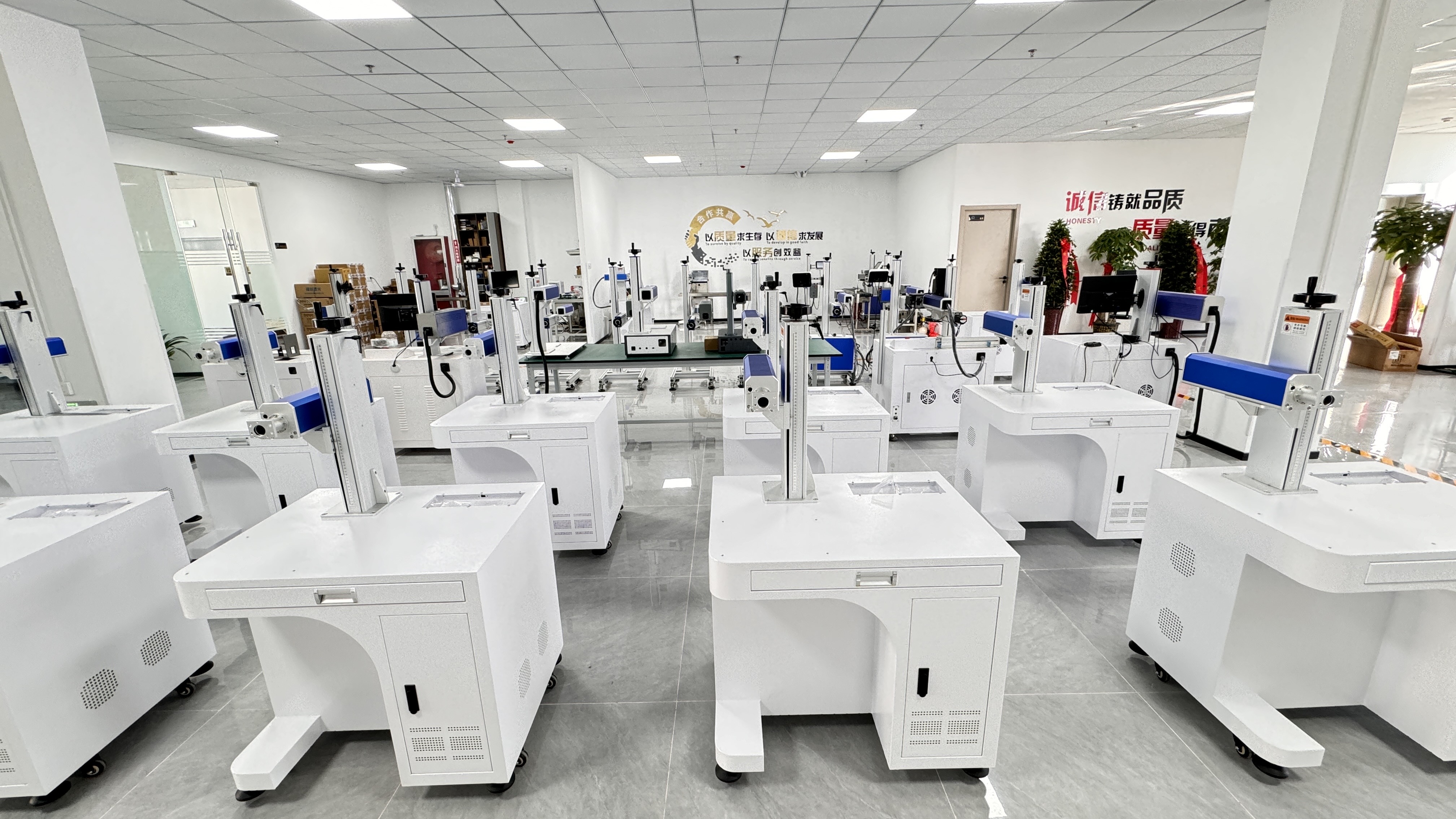
The desktop UV laser marking machine supplied by Jinan Yuanshida International Trade Co., Ltd. is specified as follows:
- Wavelength and pulse width: 355 nm, pulse width less than 60 ns.
- Laser power: 3 W or 5 W (optional).
- Modulation frequency: 30 to 100 kHz.
- Beam quality: M2 < 1.5 (single mode).
- Marking area: 110 mm x 110 mm.
- Minimum character size: 0.15 mm; minimum line width less than or equal to 0.4 mm.
- Repeatability: +/- 0.001 mm.
- Marking speed: less than or equal to 10,000 mm/s; maximum marking depth less than 0.4 mm.
- Cooling: external industrial water chiller (DWUV-05 included).
- Control: standard USB interface; 140+ font libraries, with custom fonts addable on request.
- Operating voltage: 110 V to 240 V; overall power less than 400 W.
- Dimensions: 352 mm x 603 mm x 800 mm.
The compatible material set covers the packaging substrates that matter most: PE plastics, PVC plastics, metal parts, building materials, glass, film, packaging, and composite materials. Target industries listed for this configuration include food and beverage packaging, pharmaceuticals, daily chemicals, cosmetics, electronics, hardware, steel, and cement production lines.
The 0.15 mm minimum character size is the specification that matters when date codes, batch codes, or regulatory text have to fit into a small print field. Combined with +/- 0.001 mm repeatability, it supports high-density variable text and small 2D codes on curved or irregular packaging surfaces.
Portable handheld and high-speed line options
Not every packaging task needs a fixed UV station. Yuanshida's second-generation portable handheld fiber laser marking machine handles on-site marking where the package or the workpiece cannot be brought to a fixed machine. Its verified specifications include:
- Laser power: 20 W / 30 W / 50 W / 60 W (optional); wavelength 1064 nm; air cooling.
- Built-in lithium battery; 90 V to 240 V, 50/60 Hz power supply.
- Linux operating system with a 7-inch touch screen; Bluetooth, WiFi, and mobile app support.
- Laser life of about 100,000 hours; marking area 110 mm x 110 mm.
- Materials include stainless steel, carbon steel, aluminium and aluminium alloy, copper, iron, gold, silver, carbide, painted metal, acrylic, PVC, leather, and painted wood.
For continuous packaging lines that need marking in motion, the flying online laser marking machine supports line speeds up to 7,000 mm/s and an output rate of 800 standard characters per second, with a laser lifespan of 150,000 hours, a marking area of 110 x 110 mm or 150 x 150 mm (optional), repeatability of +/- 0.003 mm, and built-in air cooling.
Deployment logic: use the UV cold laser where the substrate is heat-sensitive (film, thin PE, PVC, glass, composites); use the portable handheld unit where the package must be marked in place; use the flying online unit where the line must be marked continuously at speed.
Step-by-Step: Deploying a Laser Marking Format on a Packaging Line
Adapting laser marking to a food, pharma, or cosmetics line follows a sequence. Each step below is designed to reduce rework and to make the acceptance criteria explicit before the order is placed.
- Audit the substrate, not just the product. List every packaging material the line handles, including PE, PVC, film, glass, and composite laminate, and flag which of them are heat-sensitive. This determines whether UV cold processing is required or whether a fiber or CO2 format is sufficient.
- Define the code content and the smallest character. Capture every element that must be marked: variable text, logos, barcodes, 2D codes, batch codes, and date codes. Identify the smallest character size required; if it is below roughly 0.2 mm, confirm the marking area and lens configuration against the 0.15 mm minimum character specification of the UV configuration.
- Match the format to the line layout. Choose a fixed desktop unit for a dedicated station, a portable handheld unit for multiple stations or immovable workpieces, or a flying online unit for continuous in-motion marking.
- Validate with a marking sample before committing. Mark the actual packaging substrate, not a substitute, and check contrast, edge definition, code readability, and whether the substrate shows any deformation or discolouration.
- Integrate with the line. Confirm the mounting position, focal distance, marking area (110 mm x 110 mm on the standard UV configuration), and the conveyor or indexing interface used to trigger each mark.
- Confirm regulatory and safety requirements. Identify the standards that apply to the destination market, for example FDA 21 CFR Subchapter J for the United States, and confirm the safety configuration of the unit: laser safety enclosure, anti-radiation observation window, safety door interlock, emergency stop, and OD5+ protective eyewear.
- Lock the commercial and customization terms. Confirm the minimum order quantity (5 units for portable laser marking machine orders), delivery terms, payment terms (deposit plus balance), and any OEM or ODM requirements covering housing, branding, interface language, or fixture design.
- Agree on acceptance and after-sales. Acceptance inspection for Yuanshida equipment includes pre-shipment aging tests and precision calibration. Confirm the acceptance procedure and after-sales channel before dispatch; the company provides full English after-sales technical support.
Use Cases Across Food, Pharma, and Cosmetics
Food and beverage packaging
Food and beverage lines mark date codes, lot codes, and best-before dates on film, PE containers, and composite packaging. The constraint is the substrate: thin film distorts under heat, and PE surfaces are difficult for ink adhesion. UV cold processing marks these surfaces without thermal distortion, and the mark is created in the material rather than applied to it.
Pharmaceutical packaging
Pharmaceutical packaging requires traceability and permanence. Batch codes, serial numbers, and expiry dates must survive handling and remain legible and scannable. A 0.15 mm minimum character size supports the small print fields typical of pharma packaging, and +/- 0.001 mm repeatability supports consistent code placement across a production run. The company reports scannable-code performance targets of 99.9% reading accuracy for 2D QR codes and barcodes on marked surfaces, together with wear-resistant and tamper-proof serial numbers, batch codes, and dates.
Daily chemicals and cosmetics
Cosmetics and daily chemical packaging combines brand presentation with regulatory coding. Logos and decorative text sit alongside batch and date codes on the same package. A UV cold laser marks both brand elements and variable data on PE, PVC, glass, and composite packaging, including coloured and coated surfaces, without melting or discolouring the finish.
Compliance and safety context
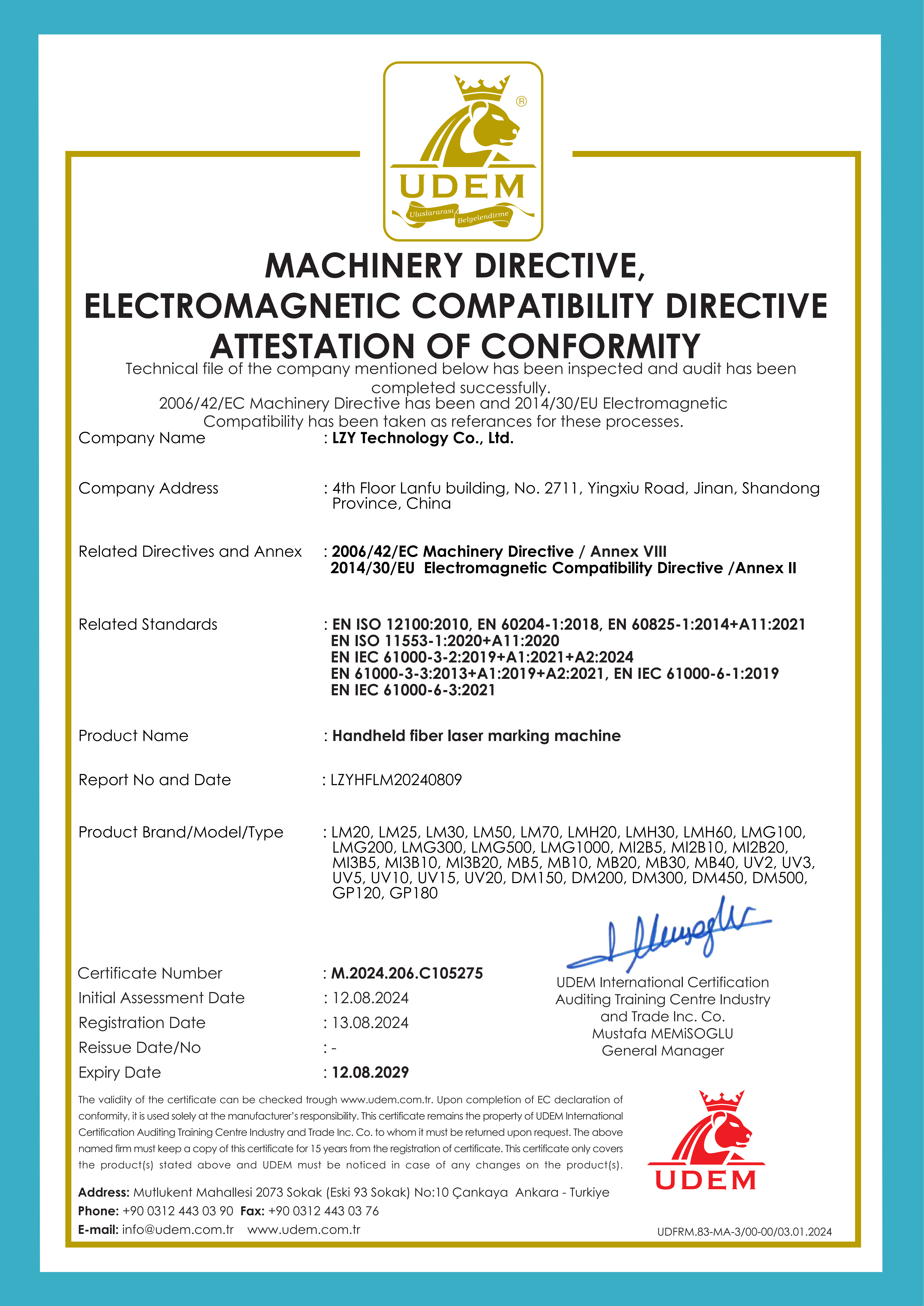
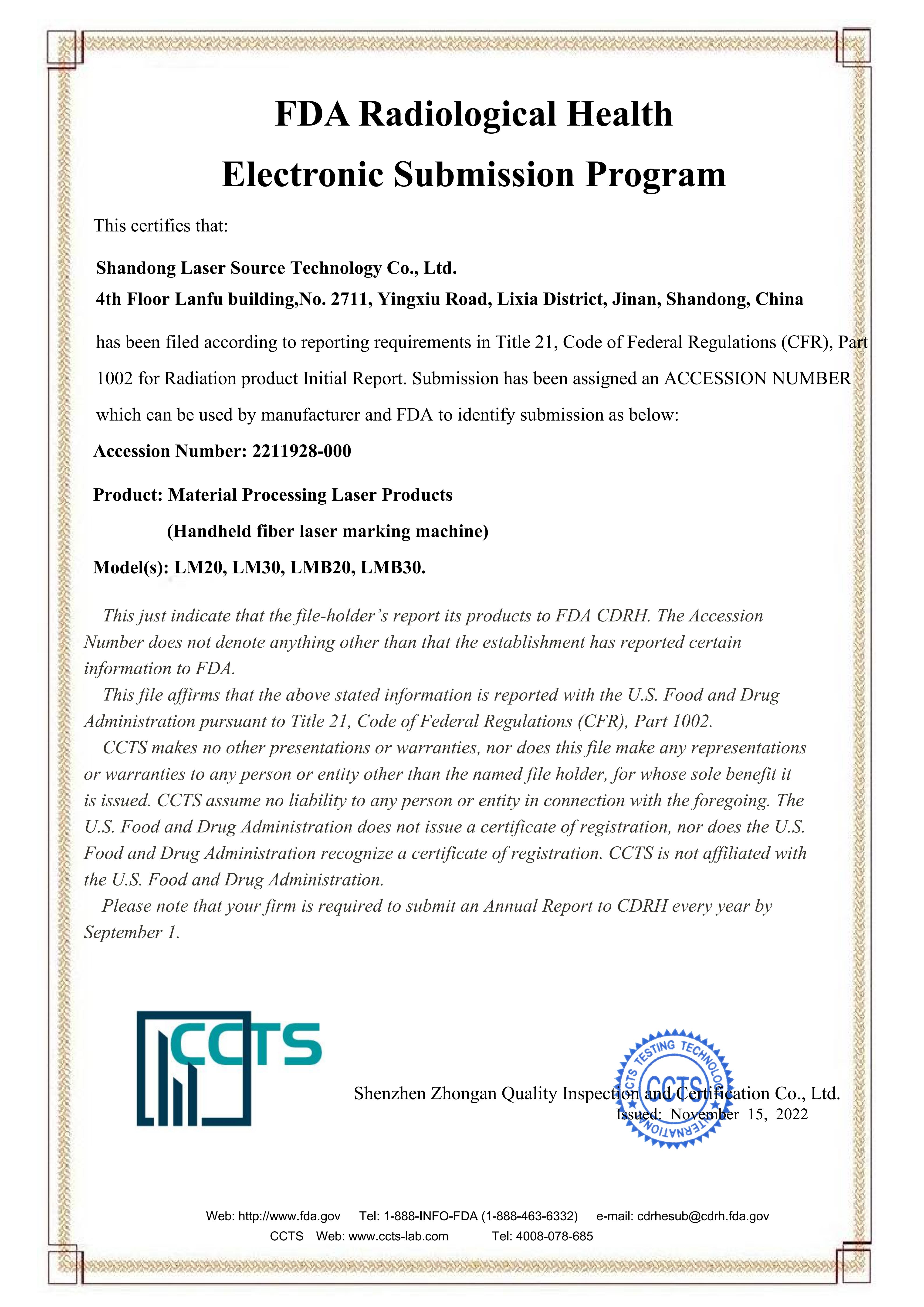
Yuanshida equipment is described as complying with international quality standards including CE, FDA, and ISO, and as designed to meet certification and customs clearance requirements in a range of markets. The company holds a CE Declaration of Conformity (certificate M.2024.206.C105275, issued 2024-08-12 and valid to 2029-08-12) covering the handheld fiber laser marking machine, assessed against standards including EN ISO 12100:2010, EN 60204-1:2018, EN 60825-1:2014+A11:2021, and EN ISO 11553-1:2020+A11:2020. It also holds an FDA Radiological Health Electronic Submission Confirmation (2211928-000) under Title 21 CFR Part 1002, with the same handheld fiber laser marking machine scope.
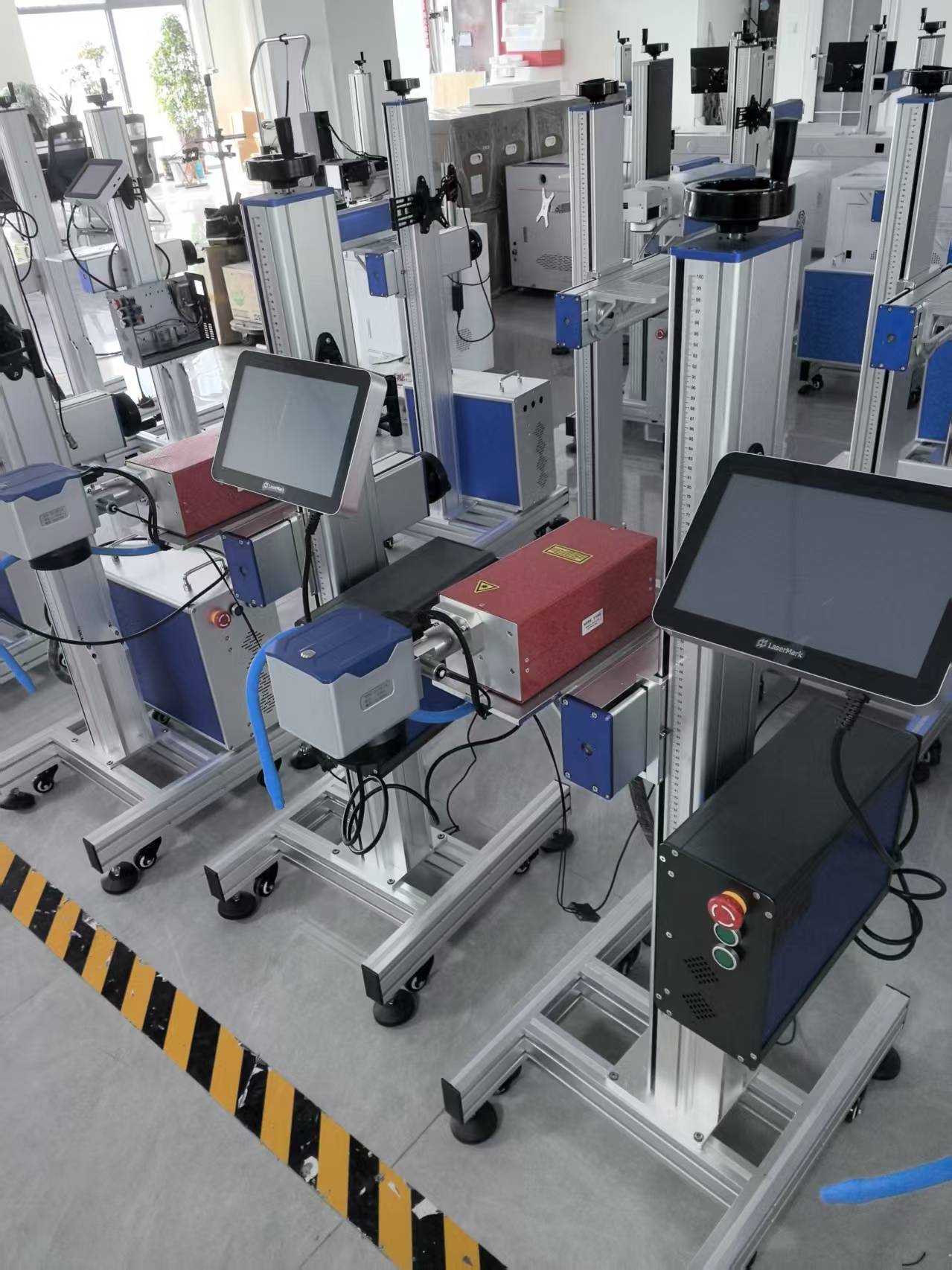
On the safety side, the equipment is built with a Class 4 laser safety enclosure, an anti-radiation observation window, a safety door interlock that halts laser output when the door opens, an emergency stop button, and OD5+ certified anti-laser protective eyewear. Electrical protection includes overload protectors, a residual current circuit breaker (RCCB), and grounding protection, with automatic thermal shutdown and alarm for the laser source and power supply. Every machine undergoes a 72-hour continuous full-load aging test and insulation withstand voltage testing before dispatch.
Comparison: Which Laser Marking Format Fits Which Packaging Line
The table below compares the laser marking formats relevant to packaging lines, using verified specification data.
| Format | Wavelength / Pulse Width | Marking Area | Cooling | Compatible Materials | Best Fit |
|---|---|---|---|---|---|
| Desktop UV Laser Marking Machine | 355 nm / less than 60 ns | 110 x 110 mm | External industrial water chiller (DWUV-05) | PE, PVC, glass, film, packaging, composite materials, metal parts, building materials | Heat-sensitive food, pharma, and cosmetic packaging |
| Desktop CO2 Laser Marking Machine | 10.6 um / less than 60 ns | 110 x 110 mm or 150 x 150 mm | Built-in air cooling | Glass, leather, cardboard and paper boxes, PET and mineral water bottles, wood, non-metallic packaging | Non-metallic packaging and cardboard |
| Flying Online Laser Marking Machine | 1064 nm | 110 x 110 mm or 150 x 150 mm | Built-in air cooling | Metals, PE, PVC, electronic components, building materials, packaging substrates | Continuous in-motion packaging lines |
| Second Generation Portable Handheld Fiber Laser Marking Machine | 1064 nm | 110 x 110 mm | Air cooling | Stainless steel, carbon steel, aluminium, copper, iron, gold, silver, carbide, painted metal, acrylic, PVC, leather, painted wood | On-site marking where the package cannot be brought to a fixed machine |
The comparison makes one point clear: format selection follows the substrate and the line layout, not the brand. A UV cold laser is the right answer when the substrate is heat-sensitive; a flying online unit is the right answer when the line must be marked in motion; a portable handheld unit is the right answer when the marking position has to move.
Frequently Asked Questions
1. Which compliance and safety requirements apply to laser marking on food, pharma, and cosmetic packaging lines?
Laser products sold in the United States must comply with FDA 21 CFR Subchapter J (Radiological Health), Parts 1000 through 1005, and portable laser markers are assessed against EN ISO 11553-2 for hand-held safety in the EU and international context. Yuanshida holds a CE Declaration of Conformity (M.2024.206.C105275) and an FDA Radiological Health Electronic Submission Confirmation (2211928-000), both scoped to the handheld fiber laser marking machine, and states that its equipment complies with CE, FDA, and ISO standards. On-machine safety features include a Class 4 laser safety enclosure, an anti-radiation observation window, a safety door interlock, an emergency stop, and OD5+ protective eyewear.
2. Can a portable laser marking machine mark heat-sensitive PE, PVC, film, glass, and composite packaging?
Yes, when the machine uses UV cold processing. The desktop UV laser marking machine operates at 355 nm with a pulse width under 60 ns, which breaks surface bonds photochemically rather than thermally, so heat-sensitive substrates are marked without melting or discolouring. Its compatible material set includes PE plastics, PVC plastics, films, packaging, glass, and composite materials, and its target industries include food and beverage packaging, pharmaceuticals, and daily chemicals and cosmetics.
3. What is the minimum order quantity for a portable laser marking machine?
The minimum order quantity is 5 units for portable laser marking machine orders. Payment terms are deposit plus balance. Delivery terms are typically based on complete machines plus international shipping solutions, with specific terms such as EXW, FOB, or CIF confirmed with sales. OEM and ODM services are available, and production services include customized solution development alongside standard OEM/ODM production modes.
4. Can I validate marking quality on my own packaging before ordering?
Yes. Substrate validation is the recommended first step: mark the actual packaging material and check contrast, edge definition, code readability, and whether the substrate shows any deformation. Acceptance inspection for Yuanshida equipment includes pre-shipment aging tests and precision calibration, and the specific acceptance procedure, whether on-site acceptance, remote testing, or third-party inspection, is negotiated and confirmed with the customer. A sample or marking trial can be requested before committing to a production order.
5. What determines lead time and after-sales support?
Lead time is set by factory scheduling, which depends on order volume at the time of the order. All machines undergo aging tests and precision calibration before delivery, a one-year warranty is provided, and the company provides full English after-sales technical support. To confirm current scheduling for your order, and to request a marking sample or a quotation for a portable or desktop configuration, contact Yuanshida through the product brochure or the contact details below.
Conclusion
Adapting a portable laser marking machine to food, pharma, and cosmetic packaging lines is a substrate question before it is a machine question. Heat-sensitive PE, PVC, film, glass, and composite packaging need a process that marks without melting; a 355 nm UV cold laser with a pulse width under 60 ns does exactly that, with a 110 mm x 110 mm marking area, a 0.15 mm minimum character size, and a compatible material set built around packaging substrates. Where the line runs continuously, a flying online unit marks in motion; where the marking position must move, a portable handheld unit brings the laser to the package.
Jinan Yuanshida International Trade Co., Ltd. supplies portable handheld, desktop, and benchtop laser marking equipment to customers in Vietnam, Thailand, Malaysia, Turkiye, the United States, Poland, and the Middle East, with products exported to more than 80 countries and regions, and offers OEM/ODM services, a 5-unit MOQ, and full English after-sales support. For buyers in the evaluation and execution stage, the practical next step is to validate a marking sample on the actual packaging substrate and then confirm the format, MOQ, and delivery terms for the specific line.
Request a Marking Sample or Quotation
Send your packaging substrate sample and code specification to confirm whether UV cold laser, fiber, or CO2 marking fits your line. Yuanshida provides OEM/ODM customization, a 5-unit minimum order quantity, and full English after-sales support.
Jinan Yuanshida International Trade Co., Ltd.
Web: www.yuanlaser.com
Email: cheng@yuanlaser.com
WhatsApp: +86 156-2882-7593
Contact: Yuanyuan
Address: Room 909, Unit 1, Building 1, Kangqiao Yidong Mansion Complex, No. 5326, Aoti Middle Road, Shunhua Road Subdistrict, Jinan Area, China (Shandong) Pilot Free Trade Zone
Have Questions or Need More Details?
Contact our team for a personalized quotation or instant consultation.
Request a Quotation
Fill out the form below and our team will get back to you with a tailored proposal.
WhatsApp Direct Chat
Prefer to chat in real-time? Message us on WhatsApp for instant assistance & quick answers.
- Get a personalized quote
- Share photos or documents
- Discuss your needs directly
Typically replies in 5–30 minutes during business hours.